
Ancient Burial Shroud Made of Surprising Material, Scientists Find
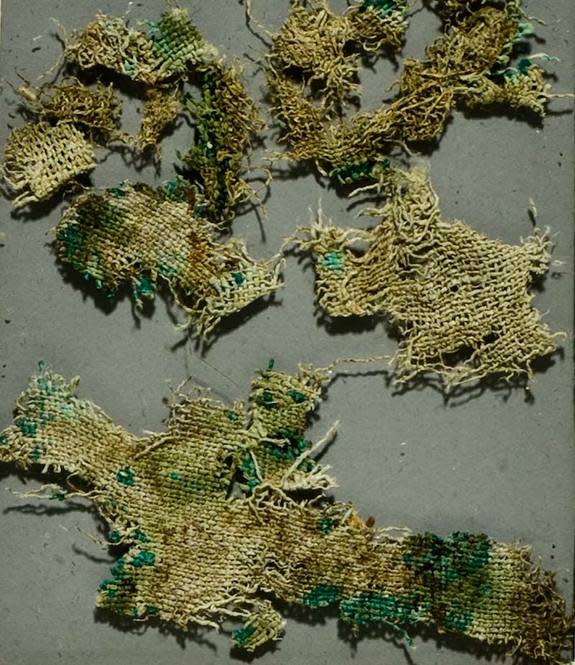
Ancient scraps of fabric found in a grave in Denmark are not made of cultivated flax as once believed, but instead are woven from imported wild nettles, suggesting the grave's inhabitant may have traveled far for burial.
This discovery, announced today (Sept. 28) in the journal Scientific Reports, casts a new light on the textile trade in Bronze Age Europe, said study researcher Ulla Mannering, an archaeologist at the University of Copenhagen.
"Since the Stone Age, they had very well-developed agriculture and technology for producing linen textiles," Mannering told LiveScience. "So it's really unusual that a society which has established agriculture would also take in material from things that are not of the normal standardized agricultural production" — in other words, wild plants.
A luxurious shroud
The soft and shiny fabric dates back to between 940 B.C. and 750 B.C., making it about 2,800 years old. It was discovered in Voldtofte, Denmark, at a rich Bronze Age burial ground called Lusehøj. The Bronze Age ran from about 3200 B.C. to 600 B.C. in Europe.
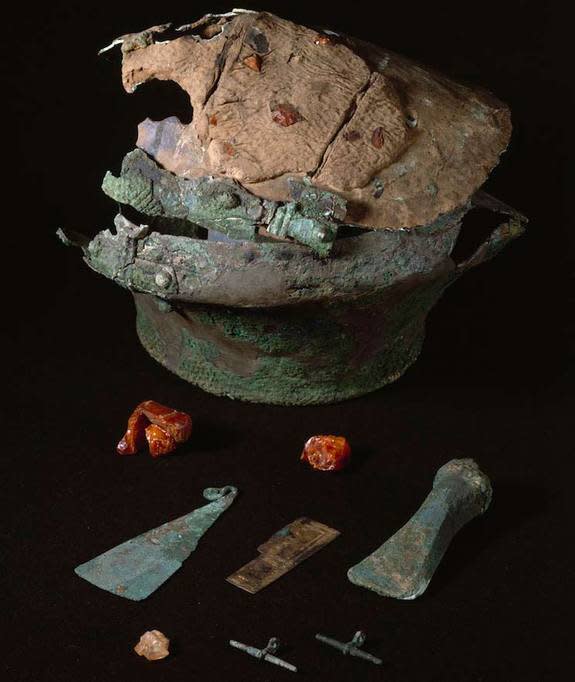
The fabric was wrapped around a bundle of cremated remains in a bronze urn. It was a luxurious piece of material, Mannering said. [10 Weird Ways We Deal With the Dead]
"The fibers we get from the European nettle are very, very fine and soft and shiny, and we often say this is a sort of prehistoric silk textile," Mannering said. (Silk, made from insect cocoons, is known for its shimmery texture.)
Previous analysis pegged the Danish fabric as woven from flax, a plant widely cultivated in the region. But along with nanophysicist Bodil Holst of the University of Bergen in Norway, Mannering and her colleagues used advanced methods to reanalyze the scraps of cloth. By studying the fiber orientation as well as the presence of certain crystals found in plants, the researchers were able to learn that the fabric is not flax at all, but nettle, a group of plants known for the needlelike stingers that line their stems and leaves.
Nor is the nettle local, Mannering said. Different soil regions contain different variations of elements. The variation of one of these elements, strontium, found in the fabric, was not local to Denmark, suggesting the plants the textile was made from grew elsewhere.
There are a few regions that match the strontium profile, the researchers found, but the most likely candidate is southwest Austria. The bronze burial urn holding the remains is from Austria, Mannering said, and it makes sense that the fabric might be too.
A well-traveled man?
Despite these imported grave goods, the remains appear to be those of a Danish man, Mannering said. The personal objects in the grave, such as two razors, suggest he was a Scandinavian, albeit perhaps a well-traveled one, she said.
"Maybe he died in Austria and was wrapped in this Austrian urn and Austrian textile and was brought back to Denmark in this condition and then put in a big burial mound," Mannering said. "The personal objects that were placed inside the urn together with this textile and the bones indicate that he is a male of Scandinavian origin, but it doesn't mean that he couldn't have died abroad."
Bronze Age Europeans lived an agricultural life and traded many goods with one another, especially the bronze that gave the era its name, Mannering said. The nettle fabric may have been an ancient luxury good for Bronze Age elite, she said.
"It shows that they also knew how to get fibers from wild plants, and they wanted these fibers probably because of their very different and unique appearance," she said.
Follow Stephanie Pappas on Twitter @sipappasor LiveScience @livescience. We're also on Facebook& Google+.
Copyright 2012 LiveScience, a TechMediaNetwork company. All rights reserved. This material may not be published, broadcast, rewritten or redistributed.
