Apple's 'iPad' is the only tablet people know

NEW YORK (AP) — Apple is on the verge of doing what few others have: change the English language.
When you have a boo-boo, you reach for a Band-Aid not a bandage. When you need to blow your nose, you ask for Kleenex not tissue. If you decide to look up something online, you Google instead of search for it. And if you want to buy a tablet computer, there's a good chance there's only one name you'll remember.
"For the vast majority, the idea of a tablet is really captured by the idea of an iPad,'" says Josh Davis, a manager at Abt Electronics in Chicago. "They gave birth to the whole category and brought it to life."
Companies trip over themselves to make their brands household names. But only a few brands become so engrained in the lexicon that they're synonymous with the products themselves. This so-called "genericization" can be both good and bad for companies like Apple, which must balance their desire for brand recognition with their disdain for brand deterioration.
It's one of the biggest contradictions in business. Companies spend millions to create a brand. Then, they spend millions more on marketing that can have the unintended consequence of making those names so popular that they become shorthand for similar products. It's like if people start calling station wagons Bentleys. It can diminish a brand's reputation.
"There's tension between legal departments concerned about 'genericide' and marketing departments concerned about sales," says Michael Atkins, a Seattle trademark attorney. "Marketing people want the brand name as widespread as possible and trademark lawyers worry ... the brand will lose all trademark significance."
It doesn't happen often. In fact, it's estimated that fewer than 5 percent of U.S. brand names become generic. Those that do typically are inventions or products that improve on what's already on the market. The brand names then become so popular that they eclipse rivals in sales, market share and in the minds' of consumers. And then they spread through the English language like the common cold in a small office.
"There's nothing that can be done to prevent it once it starts happening," says Michael Weiss, professor of linguistics at Cornell University. "There's no controlling the growth of language."
FIGHTING BACK
A company's biggest fear is that their brand name becomes so commonly used to describe a product that a judge rules that it's too "generic" to be a trademark. That means that any product — even inferior ones — can legally use the name. A brand usually is declared legally generic after a company sues another firm for using its name and the case goes to a federal court.
Drug maker Bayer lost trademarks for the names "aspirin" and "heroin" this way in the 1920s. So did B.F. Goodrich, which sued to protect its trademark of "zipper" in the 1920s after the name joined the world of common nouns. Similar cases deemed "escalator" generic in 1950, "thermos" generic in 1963 and "yo-yo" generic in 1965.
It's difficult to quantify how much revenue a company loses when its brand is deemed generic. But companies worry that it breeds confusion among consumers.
To prevent their names from becoming generic, some companies use marketing to reinforce their trademarks. For instance, after its Band-Aid brand name started becoming commonly used to refer to adhesive bandages, Johnson & Johnsons changed its jingle in ads from "I'm Stuck on Band-Aid" to "I'm Stuck on Band-Aid brand."
Kleenex uses "Kleenex brand" instead of just "Kleenex" on its packaging and in marketing and places ads to remind people Kleenex is trademarked. And the company contacts some people who use Kleenex generically to refer to tissue in order to correct them.
"We've worked very hard to keep 'Kleenex' from going the route of 'escalator' and 'aspirin,'" says Vicki Margolis, vice president and chief counsel, intellectual property and global marketing for Kimberly-Clark, which owns Kleenex. "If we lose the trademark, people can use it with sandpaper and call that a Kleenex."
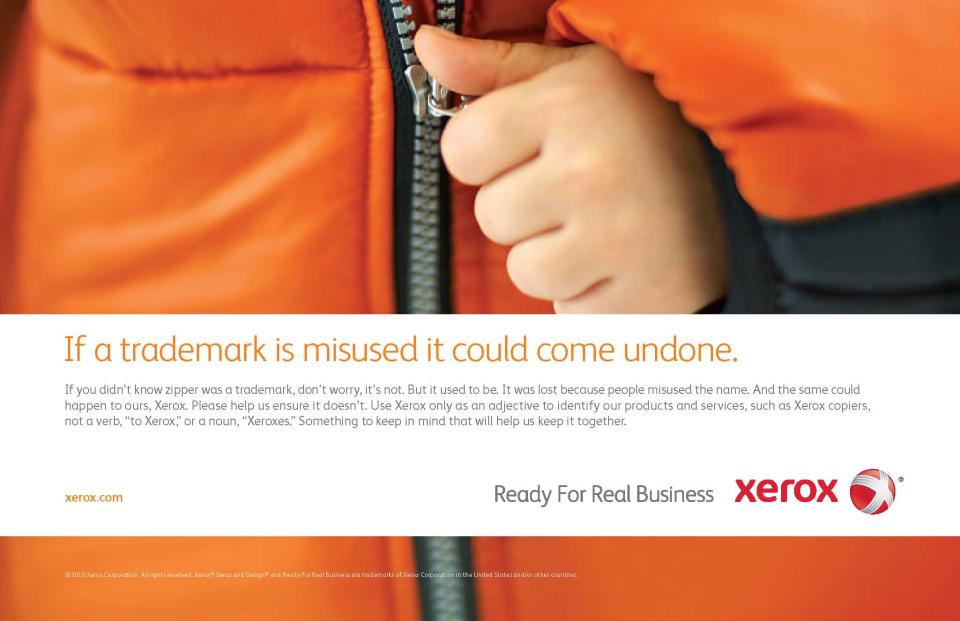
Xerox is taking a similar route. The company, which introduced the first automatic copier in the U.S. in 1959, has been on a public crusade for decades to keep its brand from becoming generic. The machine's success has led people to start using "Xerox" to refer to any copying machine, copies made from one and the act of copying.
"In the mid- to late-1970s, we ran dangerously close to Xerox becoming 'genericized,'" says Barbara Basney, vice president of global advertising. "That prompted a lot of proactive action to protect our trademark."
Xerox has spent millions taking out ads aimed at educating so-called "influencers" like lawyers, journalists and entertainers about its brand name. A 2003 ad said: "When you use 'Xerox' the way you use 'aspirin,' we get a headache." More recently, a 2007 ad read: "If you use "Xerox" the way you use "zipper," our trademark could be left wide open."
While people still use "Xerox" generically — the Merriam-Webster dictionary lists the word as both a lower-case verb with the definition "to copy on a xerographic copier" and a trademarked noun — the brand says its campaign has been a success.
Xerox is still popular: It's ranked the 57th most valuable global brand, worth $6.4 billion, according to brand consultancy Interbrand. And perhaps most importantly, Xerox hasn't lost its trademark.
TAKING IT IN STRIDE
Sometimes companies embrace when their brands become common nouns.
Perhaps the best example of this is Google, a company created in 1998 when Alta Vista and Yahoo.com were the top online search engines. Google, which created a formula that returned more accurate results than its competitors, became so popular that people began saying "Google" to refer to a Web search, in general. Experts say Google has benefited from its name becoming a part of the lexicon.
"You don't say 'Why don't I Google it' and go to Yahoo or Bing," says Jessica Litman, professor of copyright law at the University of Michigan Law School, referring to other search engines.
Apple also has gotten a boost from its brand names becoming synonymous with products. The iPod, which was the first digital music player when it came out in 2001, is still the name people use for "digital music player" or "MP3 player." And it appears Apple's iPad is headed down the same path.
For consumers like Mary Schmidt, 58, the "iPad" is generic for "tablet." Schmidt, a Baltimore marketing executive, owns an iPad and doesn't know the names of any other tablets.
"When I think of tablets, I think of an iPad," she says. "I think it's going to be the generic name. They were first."
It remains to be seen if the iPad will maintain its name domination in the tablet market. Apple declined to comment for this article.
For now, Apple Inc. has a majority of the tablet category, which includes Amazon's Kindle Fire and Samsung Electronics Co.'s Galaxy Tablet. The iPad accounted for about 73 percent of the estimated 63.6 million tablets sold globally last year, according to research firm Gartner.
Apple's market share is likely to decline as more rivals roll out tablets. But experts say that won't necessarily diminish iPad's name recognition.
"Apple is actually pretty good at this," says Litman, the law school professor. "It's able to skate pretty close to the generics line while making it very clear the name is a trademark of the Apple version of this general category."
When the iPad debuted in 2010, some people offered up "Apple Tablet" or the "iTab" as better names. Others even suggested that the name sounded more like a feminine hygiene product than a tablet: "Get ready for Maxi pad jokes and lots of 'em!" wrote tech site Gizmodo at the time.
Two years later, those complaints are all but forgotten.
"At the end of the day, the product was so successful that even if it wasn't the 'quote unquote' best name, it made the name synonymous with the category," says Allen Adamson, managing director at branding firm Landor.
