

Battle-Scarred Skull of Suspected King Richard III Revealed
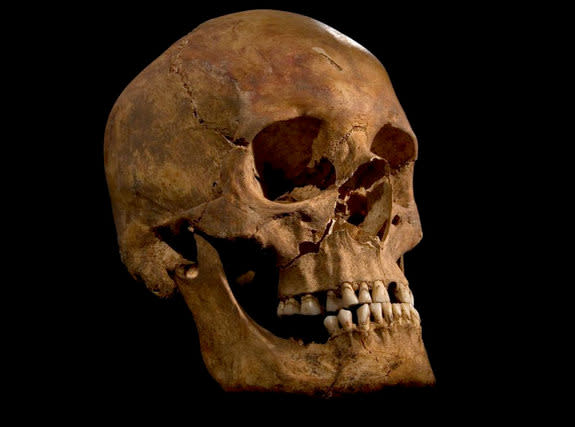
A battle-scarred skull discovered beneath a parking lot in England could be that of King Richard III, who died in battle in 1485.
The University of Leicester released the skull image — the first photo of the human remains that may belong to the English monarch — ahead of a big announcement on the identity of the bones, scheduled for Monday (Feb. 4) morning.
"The skull was in good condition, although fragile, and was able to give us detailed information about this individual," Jo Appleby, an archaeologist at the University of Leicester, said in a statement.
Archaeologists had unearthed the skeleton, including its skull, last year in the choir of what was the medieval church Grefriars, which had been buried under a parking lot. Historical records suggested King Richard III was buried there after he died at the Battle of Bosworth Field, during the War of the Roses, an English civil war.
To get as close a look as possible at the skull, and find out whether it once held the English crown, researchers used computed tomography (CT) scanning.
"In order to determine whether this individual is Richard III we have built up a biological profile of its characteristics. We have also carefully examined the skeleton for traces of a violent death," Appleby said. [See Images of the Skull & Search for Richard III's Grave]
Skeletal signs
Appleby and colleagues had good reasons to think the remains came from the famous king, best known through William Shakespeare's fictional account of him in "Richard III." For instance, not only was the skeleton male, it was found in the church choir area where historical records would suggest Richard III was buried. The skull also showed signs of being wounded, as if it were cut clean off his body with an axe or sword, something consistent with a battle death.
Scientists also found a barbed arrowhead in the skeleton's spine, which showed signs of scoliosis. Such an abnormally curved spine would've made its owner's right shoulder sit higher than the left, matching contemporary portrayals of Richard III. However, unlike some later accounts, the king was not a hunchback.
The CT scans will allow scientists to create a 3-D image of the body, over which they can place flesh; same goes for the skull, which the team plans to reconstruct to show what the man's face would've looked like, though this procedure can be somewhat unreliable. The team also said they would analyze any DNA recovered from the bones. Such results could then be compared to those of a direct descendant of Richard's sister, who was uncovered by John Ashdown-Hill, author of "The Last Days of Richard III." From those remains, scientists have mitochondrial DNA, or the DNA inside the cell's energy-making structures, which gets passed down only by mothers.
Strange tales
Richard III ruled from 1483 to 1485, becoming the last English king to die in battle. Though it was known the king was buried at the Franciscan Friary (known as Greyfriars) in Leicester, the grave and church itself were eventually lost. Even so, interest in the king led to some far-fetched grave tales about the grave's whereabouts, including one purporting the bones were thrown into the Soar River. "Other fables, equally discredited, claimed that his coffin was used as a horse-trough," Philippa Langley, a Richard III Society member, said in a statement.
The researchers started digging beneath the Leicester City Council parking lot on Aug. 25. Since then, they have found the church and a 17th-century garden marked by paving stones. Records suggest mayor of Leicester Robert Herrick built a mansion and garden on the medieval church site years after the king's death, reportedly placing in the garden a stone pillar inscribed with, "Here lies the body of Richard III sometime King of England." [10 Weirdest Ways We Deal With the Dead]
If the bones turn out to belong to King Richard III, where will they be re-interred? The University of Leicester has jurisdiction over the remains, and had said last year the remains would be buried under Leicester Cathedral.
However, other interested parties have their own opinions: The Richard III Foundation and the Society of Friends of Richard III, based in York, England, argue the remains should be reburied in York, since the king was fond of that city. The Richard III Society has remained officially neutral. Meanwhile, some online petitions have argued the reburial should take place at Westminster Abbey or Windsor Castle.
"If the identity of the remains is confirmed, Leicester Cathedral will continue to work with the Royal Household, and with the Richard III Society, to ensure that his remains are treated with dignity and respect and are reburied with the appropriate rites and ceremonies of the church," the Very Reverend Vivienne Faull, the Dean of Leicester, said in a statement.
Follow LiveScience on Twitter @livescience. We're also on Facebook & Google+.
Copyright 2013 LiveScience, a TechMediaNetwork company. All rights reserved. This material may not be published, broadcast, rewritten or redistributed.
