 The Lookout
Arizona’s illegal-immigration law heads to Supreme Court. Will justices strike it down?
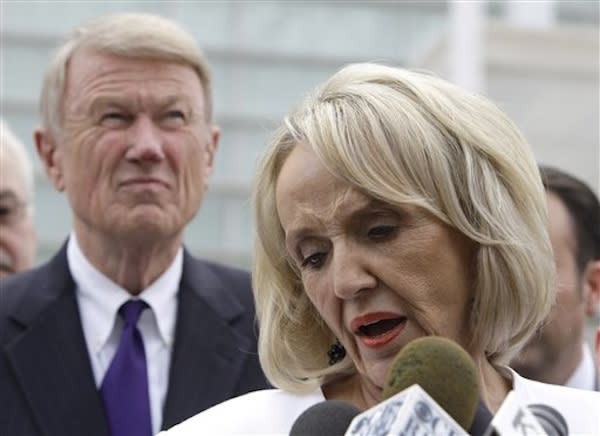
Arizona Gov. Jan Brewer signed the country's toughest illegal-immigration bill into law two years ago, setting off a long legal battle with the Obama administration and inspiring half a dozen states to emulate Arizona and pass similar laws. On Wednesday, the federal government and Arizona will face off at the Supreme Court, where Justice Department lawyers will try to convince the court that the law is an unconstitutional invasion into the federal government's turf.
A federal judge blocked four major aspects of the law before they ever went into effect, including the provision that local police officers check the immigration status of people during stops if they have reason to suspect they lack legal status. Provisions making it a state crime for illegal immigrants to seek work, or for any immigrant to fail to carry immigration papers, were also blocked. Last year, the 9th U.S. Circuit Court of Appeals upheld a lower court's decision and shot down most of the law.
Although public opinion polls showed that most Americans supported the law's provisions after it passed, the minority opposition was passionate, and it set off a national debate about illegal immigration that has permeated the presidential elections. Opponents argued that the law would encourage racial profiling and branded Arizona the "show me your papers" state. More than 100 different parties, including former Secretary of State Madeleine Albright and dozens of states, have filed friend-of-the-court briefs weighing in on the law.
Three interesting twists are likely to make this case even more high-profile—and political—than it already has been. First of all, Mitt Romney and other Republican candidates for the presidency have blasted the Obama administration for suing Arizona in the first place, using it as a way to paint the president as soft on illegal immigration and intrusive on states' rights. Secondly, a familiar face will represent Arizona's case: Paul Clement, the lawyer who argued against Obama's health care law before the Supreme Court earlier this month, will once again take center stage. Lastly, Justice Elena Kagan has recused herself from the case because she was solicitor general when the government first filed suit against Arizona. That means the court could theoretically split 4-4 in its decision. If this happens, the 9th Circuit decision stands and the law will remain blocked. But that outcome would give little guidance to states not in the 9th Circuit that have passed or want to pass laws similar to Arizona's, and would leave unsettled the question of how far states can go in combating illegal immigration.
Here's a brief rundown of each side's line of reasoning:
Arizona's argument
Arizona must prove that its law represents an honest attempt to cooperate with the federal government in enforcing existing immigration laws—and that it isn't trying to create its own immigration policy.
Clement argues in his brief that national immigration law provides for state-federal cooperation, even requiring states to send and receive information about the immigration status of suspects in some cases. The federal government runs a 24-hour database where state and local law enforcement officers can look up the immigration status of accused criminals. This suggests that states can and even should help enforce civil immigration law, he argues, particularly in the scenario where an officer has lawfully stopped someone he suspects of a crime. Interestingly, Clement quotes Plyler v. Doe, a 1982 case where the Supreme Court struck down a Texas law barring undocumented children from K-12 public schools, to support his assertion that states can pass laws sanctioning illegal immigrants.
Clement also briefly dismisses the argument that Arizona's law is interfering with the United States' foreign relations, saying it cannot be an interference if it helps the federal government combat illegal immigration.
The federal government's case
The government hit Arizona particularly hard on two of the law's provisions: criminalizing those not carrying immigration papers, and criminalizing illegal immigrants who are looking for work. National immigration laws make working while unauthorized only a civil offense, and applying for work is not even a civil crime. (Lying on a federal work form about citizenship or providing false documents is a criminal offense.) This, the lawyers argue, is an example of Arizona making its own immigration policy, not just trying to help the federal government enforce its existing laws.
The government's other main argument just might be its strongest: that Arizona's law infringes on the federal government's ability to control foreign relations. (The Constitution makes clear that the states have no legal role in foreign policy and affairs.) Arizona State University law professor Paul Bender tells Yahoo News that this is the government's best shot. "To have 50 states able to decide on their own who they're going to detain and put in jail without the federal government's permission is an invitation to disaster," he says. In the majority opinion, the 9th Circuit mentioned that five out of six Mexican border governors declined an invitation to travel to a conference in Arizona in protest of the law, and that the leaders of dozens of foreign countries and United Nations human rights officials had publicly criticized it. One 9th Circuit judge rejected this argument in his dissent, calling it a "heckler's veto."
The federal government's toughest job will most likely be to convince the justices that the Constitution prevents the policy of requiring police officers to ask people about their immigration status during stops. That's because Clement brings up fairly convincing examples of pre-existing cooperation between the federal and local governments in this case, through the 24-hour database and other programs.
Correction: An earlier version of this article misstated Paul Clement's name.
More popular Yahoo! News stories:
• Sanford Police Chief Bill Lee to step down: report
• Wrigley Field fake bomber pleads guilty to federal charges
