
 The Lookout
Pearl Harbor recollections: how war wove families’ fortunes
Friday marks 71 years since the attack on Pearl Harbor—certainly not an exceptional anniversary—but for those whose futures were altered by Japan's attack on the U.S. naval base, details from Dec. 7, 1941, stick fresh no matter how many years have passed.
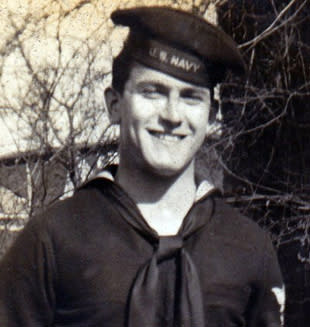
Ted Sherman in his U.S. Navy uniform in 1942. (Photo courtesy of Ted Sherman)
Ted Sherman, then 16, learned of the attack while seeing "Sergeant York," a film about a World War I hero, at a local Philadelphia movie theater. He remembers the screen going dark, the manager coming on stage to deliver the news, and boys crowding outside the theater to talk about quitting school to enlist in the military. The next day, Sherman watched his 19-year-old brother sign up at an Army recruiting office. Then, a week later, came the sobering images during a senior-class trip to Washington, D.C.: soldiers with machine guns and rifles guarding rooftops and entrances of the Capitol building.
"Most of us had never heard of Pearl Harbor, and as the implications of the attack became clear, we were fired with the growing anger that was just beginning to sweep across the country," Sherman writes in a first-person account for Yahoo News.
Eager to enlist, but still too young, Sherman had to wait what he calls "an anxious year" before joining the Navy. He writes:
"After boot camp in 1943, I was assigned as a crewman on a troop transport. While carrying Marines to the Pacific battles, we sailed through Pearl Harbor. It was two years after the attack, and much of the damage had been repaired.
"However, as we passed by the site, we could still see the grim image of the destroyed battleship USS Arizona just below the surface. There were bubbles of escaping oil still breaking the surface. It was as if the ghosts of the 1,177 sailors below were urging us to remember Pearl Harbor."
Sherman's anecdotes are several that Yahoo News collected this week from Americans who either distinctly recall Dec. 7, 1941, and the years that followed, or felt the attack deeply affect their families. Here are some of their stories.
Pearl Harbor remembered through a grandfather's diary

Lt. Col. William A. Darden is awarded the Bronze Cross in World War II. (Photo courtesy of Kathryn E. Darden)
America's fortunes—and much of those of Kathryn E. Darden's family—are traced in brisk, to-the-point diary entries her grandfather recorded during the war. Some excerpts:
Dec. 7, 1941: "Japs made surprise attack on Pearl Harbor, 2117 men killed, 960 missing, 876 wounded."
Dec. 8: "U.S. Declared War on Japan"
Dec. 11: "US declares war on Germany and Italy."
Nov. 18, 1942: "William Allen Darden Jr. now a 1st Lieut. US Engineers."
The latter entry is about Kathryn's father, who served in the Army as a lieutenant colonel with the Corps of Engineers. She learned about her father's military life—which began in 1931 after he joined college ROTC—through her late grandfather's diary.
"My father wanted to talk about his war days when I was a teen, but with the callowness of youth, I didn't want to listen then. By the time I was ready to hear his war stories, my father was gone," she writes. "While it was my father who served in World War II, it's from my grandfather's diary that I have learned the most about how Pearl Harbor impacted my family."
William Allen Darden Sr., Kathyrn's grandfather, added to the diary daily between 1938 and 1944, also detailing brief observations about the war effort back home. A Nov. 18, 1942, entry is especially brief: "Registered for gasoline rationing. 4 gallons per week."
"The rationing, coupled with her worrying about her new husband and her two brothers, is what my mother remembered most when I once asked her about Pearl Harbor," Kathryn writes about her parents. "She married Dad in 1939 and he was off to war just three years later. My grandfather, from whom I learned so much, died in 1955."
[Related: Famous Pearl Harbor quotes]
Fears of Japanese bombardment in Utah

SFC John T. Jones, left, and SFC Ted Olean in Korea in 1951. (Photo courtesy of John T. Jones)
John T. Jones, a month shy of his 10th birthday, remembers scanning the skies near his Utah home with his cousin Billy, worried his family would fall victim to Japanese bombers.
"We were at war and war meant that no place was safe," he recalls, also noting fears about bomb-bearing balloons that the Japanese sent across the Pacific during the war.
In Jones' hometown, it was the sudden appearance of colored stars in neighbor's windows that exemplified the war hitting home.
"[The stars] started out blue for a serviceman," writes Jones, "but we watched them change in the neighborhood: from blue to bronze (missing), silver (wounded) to gold (killed)." His family placed a star in their home's window for his brother, Aaron, who joined the U.S. Navy.
Too young for WWII, Jones later served in the Army as a forward observer and later a platoon sergeant in the 17th Infantry Regimental Combat Team, 7th Infantry Division, during the Korean War.
[Related: Pearl Harbor attack timeline]
Memories of a family of Japanese descent

Farmer Elijah Abe receives the Bronze Star. (Photo courtesy of Susan Abe)
Seventy-one years ago, just outside Roanoke in southwestern Virginia, Susan Abe's father, Charles Hugh, was 12 and the youngest in his half-Japanese, half-American family. Prior to the attacks on Pearl Harbor, Abe says the rural community looked past her father's shiny black hair, olive complexion and almond-shaped eyes.
"At least nobody said anything aloud to their faces, not then. Not before Pearl Harbor," she writes.
But by the evening of the attacks, the community looked on the family with suspicion. Abe asks: "What treasonous acts exactly was a young boy capable of? One who just vaguely remembered his Japanese father and spoke only country-twinged American twang?"
Her Uncle Farmer, just 16 in 1941, ran away from home, lied about his age and enlisted in the Army. Susan's father followed two years later—only 14 at the time—but the FBI caught him (twice) and sent him back home. He was allowed to transfer to the Army Air Corps, which accepted younger recruits.
"The formal historical record tells us about Japanese internment camps," Abe says. "Family scuttlebutt indicated that our family's 'half-breed' nature as well as their father's U.S. Navy service record kept them from such consideration."
Farmer served almost 15 years in the Army and received the Bronze Star. Abe's father was a senior master sergeant in the United States Air Force for almost 30 years.
Pearl Harbor reverberates decades ahead

John Levkulich receives the Purple Heart medal. (Photo courtesy of MaryAnn Myers)
For MaryAnn Myers, a self-described war bride, it wasn't World War II that exemplified Pearl Harbor. It was Vietnam.
Her father, John Levkulich, served four years in World War II overseas and in harsh battles. He was wounded three times, carrying horrific scars and a damaged lung. He was tough as nails, Myers says.
"He didn't talk much about the war," she writes. "But it was because of the bombing of Pearl Harbor that he enlisted. He left on a cold Jan. 30, 1942, a young man who'd worked in the coal mines from the age of 12. He came home a lifelong veteran."
Years later, Myers married at 19, and her husband soon joined the Air Force during Vietnam. During shore leave eight months later, the newlyweds honeymooned in Hawaii and visited the USS Arizona Memorial.
"It was a sobering experience to this naïve 19-year-old new bride," Meyer says. "The USS Arizona was never raised; the bodies were never recovered. Looking over the railing, you could see the turrets, the ship's structure. You could sense the horror of that day, death all around."
Myers notes the statistics: 2,335 American servicemen and 68 civilians were killed that day. 1,178 were wounded. Of the casualties, 1,104 men aboard the Battleship USS Arizona perished. She writes:
"I thought about the dead, I thought about the wounded. I thought about my father lying in a hospital not once but three times in some war-torn country. I thought about how proud he was to have fought for our freedom. I thought about how he loved little puppies and yet had lived through hell.
"I thought about how my grandmother waited four long years for his return. 'Johnisko,' she called him. I thought about war, then and now. And as I watched the water wash over the battleship, people all around us, my soldier husband at my side, I cried."
