YOUR FRIENDS' ACTIVITY

    The imaginary connection between tax rates and GDP

    The richest Americans currently pay a 35 percent tax on income over a certain threshold. This is a divisive subject between the two major parties that is sure to come up in the general election. Both Mitt Romney and Rick Santorum propose plans that would lower the rate to 28 percent. Newt Gingrich's plan includes a flat tax of just 15 percent. Obama favors returning the pre-Bush tax cut rate of 39 percent.

    Proponents of lowering this rate argue that higher marginal tax rates retard productivity for the highest earners, since they are reluctant to work as hard if the bulk of their income is taxed at too high of rate. Lower the rate, the thinking goes, and the rich are incentivized to earn more, thus increasing the total tax revenue and putting more money into the economy.

    Democrats point to studies like that of the Congressional Budget Office, which found that cutting income tax by 10 percent would reduce revenues by $466 billion in five years and another $775 billion in the next five years. Under the most optimistic estimates, the benefits of putting more money in people's pockets would offset 22 percent of the losses in the first five years and 32 percent in the next five, for a net loss of almost $900 billion.

    We decided to look at what the data say about the correlation between marginal tax rates and the economy. Here's a simple comparison of the marginal tax rate--that on the highest income brackets--and the rate of GDP growth or decline.
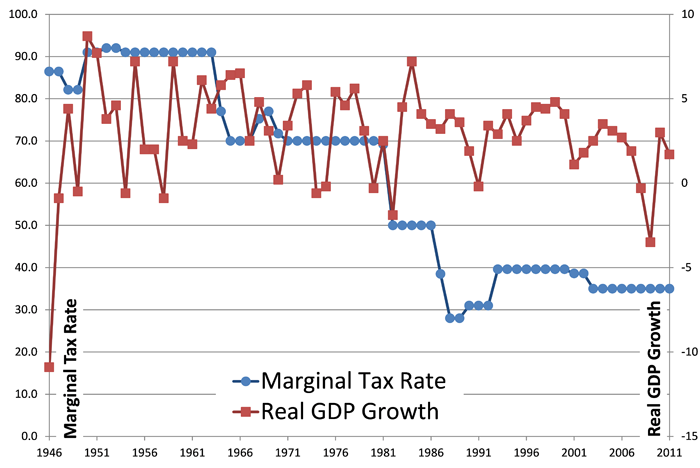
    Top Marginal Tax Rate and GDP Growth

    Sources: BEA and Tax Policy Center of Urban Institute and Brookings Institute

    As is clear, GDP growth, the all-important measure of economic strength, does not correlate with the marginal tax rate at all. GDP growth has been both strong and weak with very high and low tax rates.

    There is no question that people change their earning behavior when marginal returns vary. Right now we tax the marginal capital gain at 15 percent, a full 20 points lower than the rate for traditional income. Thus, people substitute initiatives that lead to capital gains f0r initiatives that lead to regular income. In short, the highest earners in the country are more likely to shift income between tax categories than they are to actually substitute leisure for work.

    We expect politicians to over simplify the bounty that their proposals will deliver. But the data are very clear on the point that a lower tax margin for the wealthiest earners does not positively affect the GDP in any obvious way.

    David Rothschild is an economist at Yahoo! Research. He has a Ph.D. in applied economics from the Wharton School of Business at the University of Pennsylvania. Follow him on Twitter @DavMicRot and email him at thesignal@yahoo-inc.com.

    Want more? Visit The Signal blog, connect with us on Facebook, and follow us on Twitter. Handy with a camera? Join the Yahoo! News Election 2012 Flickr group to submit your photos of the campaign in action.

    Loading...
    • Boyfriend espaces out window as husband confronts cheating wife [VIDEO]

      As part of perhaps the most spectacular walk-of-shame ever, an underwear-clad lover escaped from a third floor bedroom as the returning husband confronted his cheating wife on a balcony.

    • Indian guest workers sue company in Miss., Texas

      Dozens of Indian guest workers are suing an Alabama-based marine and fabrication company, claiming it financially exploited them and forced them to live in squalid conditions after bringing them to work ...

    • Cycling-Road-Giro d'Italia classification after stage 16

      May 21 (Infostrada Sports) - Classification from Giro d'Italia after Stage 16 on Tuesday 1. Vincenzo Nibali (Italy / Astana) 67:55:36" 2. Cadel Evans (Australia / BMC Racing) +1:26" 3. Rigoberto Uran (Colombia / Team Sky) +2:46" 4. Michele Scarponi (Italy / Lampre) +3:53" 5. Przemyslaw Niemiec (Poland / Lampre) +4:13" 6. Mauro Santambrogio (Italy / Vini Fantini) +4:57" 7. Carlos Betancur (Colombia / AG2R) +5:15" 8. Rafal Majka (Poland / Saxo - Tinkoff) +5:20" 9. Benat Intxausti (Spain / Movistar) +5:47" 10. Domenico Pozzovivo (Italy / AG2R) +7:34" 11. Tanel Kangert (Estonia / Astana) +7:43" ...

    • Why We Can't Forget That Oklahoma's Senators Voted Against Sandy Relief

      Nearly four months ago, Oklahoma Senators Tom Coburn and James Inhofe both voted against H.R.152, the Disaster Relief Appropriations Act that eventually sent $50.5 billion in relief to victims of Hurricane Sandy. And in the flurry of last night's devastation in Moore, Oklahoma. it was impossible not to forget that fact, knowing the federal government would soon rally to the cause.

    • Teens Are Turning Away from Facebook Because Tumblr Is Real, and Parent-Free

      Teenagers really are over Facebook. In February the social network warned investors that "our younger users ... are aware of and actively engaging with other products and services similar to, or as a substitute for, Facebook." And in April the investment bank Piper Jaffray reported that products and services like Tumblr and Twitter were further eroding Facebook's dominance among the Justin Bieber set. But why? In a deep report published on Tuesday, Pew Research explains that teenagers departing the social network's blue confines are looking for something more... real. ...

    • BREAKING: Subway Just as Unhealthy as McDonald’s!

      If you watched the London Olympics last summer, you saw a parade of top athletes touting the nutritional qualities of their favorite eatery: Subway. Watching Apolo Ohno or Robert Griffin III bite into a veggie footlong with avocado or hearing that Subway is “the official training restaurant of athletes everywhere,” you might get the idea that the food served at the chain isn’t that bad for you—that it’s even healthy.

    • 18-year-old’s invention can recharge a cell phone in 30 seconds

      A teenager from Saratoga, California took home one of the top prizes at the Intel International Science and Engineering Fair late last week after showing off her invention, which can fully charge a cell phone in 30 seconds or less. Eesha Khare was given the Intel Foundation Young Scientist Award and a $50,000 prize for being runner-up in the competition, which was won by a 19-year-old who unveiled a new spin on self-driving car technology. Khare’s battery technology requires a new component to be installed inside the phone battery itself, and Intel notes that it also has potential applications for car batteries.

    Loading...

    Follow Yahoo! News