Are elections as subject to chance as football games?
Commentators love to complain about how political coverage resembles sports journalism, tallying wins and losses instead of covering the issues. But while journalism professors can wave their canes all they like, we've found that football is a convenient metaphor for political matchups. In both cases, you have prediction markets that produce odds of victory in a contest that is fundamentally uncertain, and in many ways the primary and general elections resemble a multi-round playoff.
Last weekend there was major action in both arenas, with the Nevada caucuses on Saturday and the Superbowl on Sunday. A week before the primary, Romney had a 95 percent chance of winning with the state (which he did). Going into the Super Bowl, the Patriots had 57.5 percent odds, according to one major market (which they didn't). In other words, if the Super Bowl was played 100 times, the Patriots would win 57 or 58 Lombardi trophies to the Giants' 42 or 43. Likewise, in 100 Nevada caucuses, Romney only loses 5 times.
But does the analogy hold? It makes sense that a football game, which can be swayed so mightily but small circumstances, could produce wildly different outcomes in this hypothetical experiment. The idea that, even 5 percent of the time, random favors of chance could align so mightily against Romney that he'd lose the Nevada caucuses might be less intuitive. Could the vast political tides supporting Romney really reverse themselves in even a few cases?
In fact, that's exactly the case. Consider the following chart, which groups 2008 races by the likelihood of a Democratic victory (x axis) and the actual percentage of those races in which the Democrat won (y axis). If politics is like football, you'd expect the dots to hug the diagonal line—of all the candidates with roughly a 20 percent chance of winning, 2 in 10 should actually win, and so on. It was a good year for Democrats, who exceeded expectations—hence the dots being above the line in most cases—but they don't deviate as much as we'd expect if elections were more predetermined than football games.
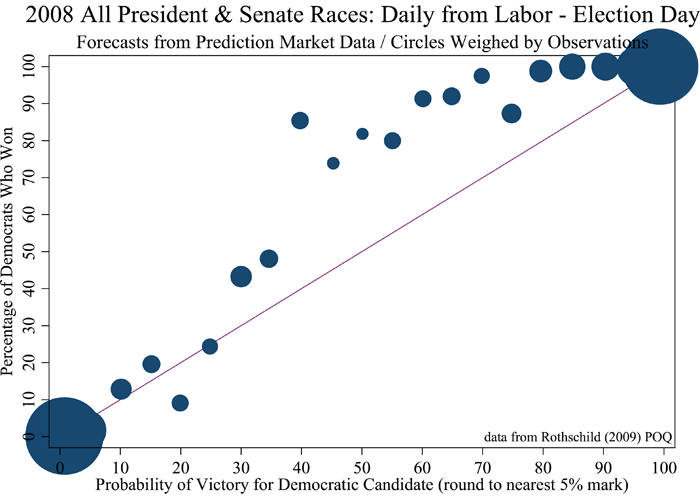
Here's one way to think about it: There are two sources of uncertainty when we model predictions for political elections and sports: incomplete information and true randomness.
First, there is information we do not know or cannot model. In politics we do not have the ability to sample all voters in our polls or eavesdrop on every candidate's strategy meetings; we can only speculate. In sports, likewise, we do not know the true state of a player's health or the coach's strategy for the team.
Second, there is randomness as to what will happen during the course of the event. In politics this includes private remarks that are captured on camera or whether a candidate knocks a question out of the park or flubs an easy one during a debate. Even the best politicians have bad nights (think of Gore's disastrous 2000 debate in Boston), just as the best receivers drop an easy pass every now and again (I am looking your way, Wes Welker).
For example, the likelihood of the Patriots pulling off a comeback last night shifted wildly on whether they allowed the Giants to score a late touchdown—and whether the Giants accepted the proposition. There was massive uncertainty on the likelihood of victory as we speculated on what their strategy would be—a symptom of incomplete information about what each team intended to do. After the Patriots decided to give up the touchdown and Giants running back Ahmad Bradshaw failed to stop short of the end zone, the uncertainty shifted to the randomness of whether Tom Brady could pull off the winning drive.
Uncertainty in sports is heavy on randomness, because information is well cataloged and easily aggregated. When we talk about a team being 57 percent likely to win the game, the uncertainty is more about the randomness of the game than it is about lack of information about the teams and players.
Uncertainty in politics may be slightly more skewed towards information than sports, but it is increasingly similar. Just as Bill James and then Billy Bean revolutionized the study of data in sports, there are increasingly sophisticated models for analyzing data for politics. More and more information is included in all of these models, leaving more and more of the uncertainty to the random "bouncing of the ball."
The trick to thinking about likelihoods in politics in the same way as sports is to think of the entire campaign as game day, not just the day voters go to the polls or caucuses. The odds of a win for the Patriots or the Giants fluctuated massively during the course of the game, just as the fates of the candidates have shifted with the political winds in many points during the primary. Even when an election looks certain for one candidate, his or her opponent does in fact occasionally pull off an upset with the perfect two-minute drill.
David Rothschild is an economist at Yahoo! Research. He has a Ph.D. in applied economics from the Wharton School of Business at the University of Pennsylvania. His dissertation is in creating aggregated forecasts from individual-level information. Follow him on Twitter @DavMicRot and email him at thesignal@yahoo-inc.com. Chris Wilson is the editor of The Signal. Follow him at @chriswilsondc.

