 The Ticket
Supreme Court upholds Obamacare individual mandate as a tax
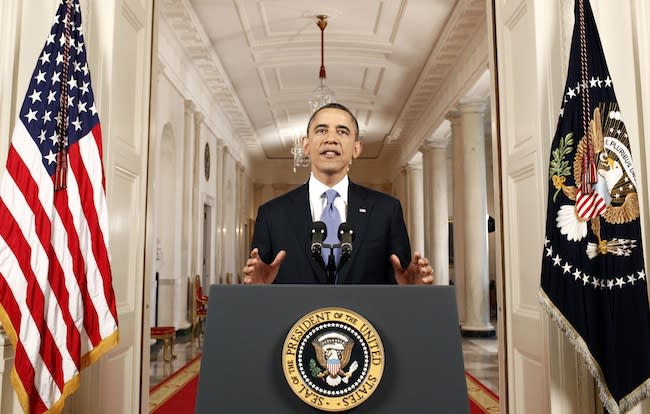
In a victory for President Barack Obama, the Supreme Court upheld his signature health care law's individual insurance mandate in a 5-4 decision, upending speculation after hostile-seeming oral arguments in March that the justices would overturn the law. The mandate has been upheld as a tax, with Chief Justice John Roberts, a Bush appointee, joining the liberal wing of the court to save the law.
[Have questions about today's Supreme Court ruling upholding the health care individual mandate? Join us for a live Facebook chat at 4 p.m. ET ]
In brief comments Thursday afternoon, Obama called the decision a win for Americans. "With today's announcement it is time for us to move forward to implement and, where necessary, to improve this law," he said. Mitt Romney told reporters shortly before noon that he would repeal the law his first day in office if elected. "ObamaCare was bad policy yesterday, it's bad policy today," he said.
The court's four liberal justices agreed that the individual mandate should be upheld as part of Congress' power to regulate interstate commerce, but Roberts disagreed, and wrote that the mandate is actually a tax, despite the Obama administration's reluctance to describe it that way during the bill's passage. In its argument to the court, the government left open the possibility that the mandate is a tax, but did not rely much on that argument. Under the law, people who do not have health insurance will have to pay 1 percent of their income to the IRS starting in 2014. (There are exceptions for some religious beliefs and financial hardship.)
"If an individual does not maintain health insurance, the only consequence is that he must make an additional payment to the IRS when he pays his taxes," Roberts writes. He adds that this means "the mandate is not a legal command to buy insurance. Rather, it makes going without insurance just another thing the government taxes, like buying gasoline or earning an income."
A footnote flagged by SCOTUSblog's Amy Howe explains the reasoning further. "Those subject to the individual mandate may lawfully forgo health insurance and pay higher taxes, or buy health insurance and pay lower taxes. The only thing that they may not lawfully do is not buy health insurance and not pay the resulting tax."
Justice Anthony Kennedy, usually the court's swing vote, dissented, reading from the bench that he and three conservative justices believe "the entire Act before us is invalid in its entirety." In a 65-page dissent, he and Justices Antonin Scalia, Clarence Thomas and Samuel Alito dismissed Roberts' arguments, writing that there is a "mountain of evidence" that the mandate is not a tax. "To say that the individual mandate merely imposes a tax is not to interpret the statute but to rewrite it," they wrote.
Twenty six states sued over the law, arguing that the individual mandate, which requires people to buy health insurance or face a fine starting in 2014, was unconstitutional. Opponents cast the individual mandate as the government forcing Americans to enter a market and buy a product against their will, while the government countered that the law was only regulating a market that everyone is already in, since almost everyone will seek health care at some point in his or her life.
Before oral arguments in March, most Supreme Court experts and scholars believed the mandate would be upheld as an exercise of Congress' power to regulate interstate commerce. But after justices seemed deeply skeptical of the mandate in oral arguments in March, the consensus flipped, with most experts guessing the court would strike down the law.
House Republicans have vowed to repeal the entire law, though it's unlikely the Democratic-controlled Senate would let that happen, and this decision may slow momentum for that move. "Today's ruling underscores the urgency of repealing this harmful law in its entirety," House Speaker John Boehner said in a statement.
Seven of the nine justices agreed that the law's expansion of Medicaid to an estimated 16 million low-income people by 2019 is unconstitutional as it was written. The court decided that the federal government cannot threaten to withdraw existing Medicaid funds from states if they don't expand Medicaid. Instead, the government can only withhold future funds. It's unclear if that will mean fewer than the 16 million projected will gain coverage.
Though the sweeping, 1,000-page plus law passed more than two years ago, much of it will not go into effect until 2014. That's when states will have to set up their own health insurance exchanges, payroll taxes will go up on higher-income workers, and Americans will have to buy health insurance (for many, with a government subsidy) or pay a penalty of 1 percent of their income to the IRS. (The penalty increases to 2.5 percent by 2016.) Employers who have more than 50 employees and don't offer insurance will also begin to face a penalty. Insurers will no longer be able to turn away people with preexisting conditions, or charge people higher premiums based on their gender or health. In August, health care plans will have to offer preventative services--including birth control--at no extra cost to customers.
An estimated 32 million uninsured people will gain coverage under the law, according to the Congressional Budget Office.
Many of the more popular provisions of the law have already gone into effect, including a regulation saying insurers have to let children stay on their parents' plans until they are 26 years old, which 2.5 million Americans have already taken advantage of. Insurers can also no longer turn away children with preexisting conditions, and sick uninsured people can buy coverage in high-risk pools set up by the government.
Despite this intentional front-loading of consumer friendly, popular provisions of the law, most of the American public either doesn't like or has no opinion on the law. Most people said they wanted the Supreme Court to strike down all or part of the law in a recent poll.

