
YOUR FRIENDS' ACTIVITY

    Conflict-Scarred Temple Uncovered Near Jerusalem
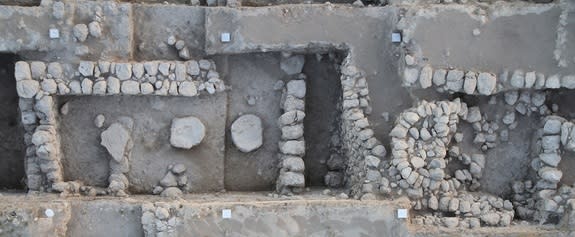
    At a biblical border city outside of Jerusalem, archaeologists have uncovered a temple from the 11th century B.C. that they say bears evidence of conflict among the ancient Israelites, Canaanites and Philistines.

    Spread across what would have been the floor at the complex at Tel Beth-Shemesh, an ancient village about 12 miles (20 kilometers) west of Jerusalem, excavators found shards of painted chalices and goblets — not the type of containers that would have been used for daily household activities. They also found animal bones surrounding a flat stone inside the building and discovered two more flat stones seemingly designed to direct liquids. Lacking the typical traces of domestic use, the excavators believe the building served as a place of worship that was possibly connected to an Israelite cult.

    But the complex didn't stay holy for long. The archaeologists found evidence that the temple was destroyed. What's more, an analysis of dirt at the site turned up microscopic remains of plants commonly eaten by livestock as well as the remnants of poop from grass-eating animals, suggesting the site was appropriated as a livestock pen.

    The excavators believe the animal takeover of the temple might represent a deliberate desecration by the Philistines, who lived alongside, though hardly peacefully, with the Israelites and Canaanites. The ancient village of Beth-Shemesh, located at the crossroads of the three groups, frequently changed hands between the Philistines and the Canaanite and Israelite populations that resisted them. The researchers say the Philistines likely gained temporary control of Beth-Shemesh and then brought in livestock to reside on what they knew had been a holy place for their enemies.

    But further evidence suggests the ancestors of the worshippers may have eventually returned. The archaeologists found several round clay ovens known as "tabuns" in the layer of soil excavated above the temple's ruins. These food-prepping features are usually found near ancient living quarters, not sacred sites, but the researchers may have an explanation for the ovens.

    "We believe that ancestors of those who had built the original complex came back to rebuild the site," archaeologist Zvi Lederman, of Tel Aviv University, said in a statement, adding that the ovens may have been used to cook feasts to honor the memory of the old temple after the Philistines pulled out of the area.

    The researchers are planning further excavations at the site and their findings will be presented this month at the annual meeting of the American Schools of Oriental Research in Chicago.

    Follow LiveScience on Twitter @livescience. We're also on Facebook & Google+.

    Copyright 2012 LiveScience, a TechMediaNetwork company. All rights reserved. This material may not be published, broadcast, rewritten or redistributed.
    Loading...

    More Science News

    • Indian guest workers sue company in Miss., Texas

      Dozens of Indian guest workers are suing an Alabama-based marine and fabrication company, claiming it financially exploited them and forced them to live in squalid conditions after bringing them to work ...

    • Boyfriend espaces out window as husband confronts cheating wife [VIDEO]

      As part of perhaps the most spectacular walk-of-shame ever, an underwear-clad lover escaped from a third floor bedroom as the returning husband confronted his cheating wife on a balcony.

    • Cycling-Road-Giro d'Italia classification after stage 16

      May 21 (Infostrada Sports) - Classification from Giro d'Italia after Stage 16 on Tuesday 1. Vincenzo Nibali (Italy / Astana) 67:55:36" 2. Cadel Evans (Australia / BMC Racing) +1:26" 3. Rigoberto Uran (Colombia / Team Sky) +2:46" 4. Michele Scarponi (Italy / Lampre) +3:53" 5. Przemyslaw Niemiec (Poland / Lampre) +4:13" 6. Mauro Santambrogio (Italy / Vini Fantini) +4:57" 7. Carlos Betancur (Colombia / AG2R) +5:15" 8. Rafal Majka (Poland / Saxo - Tinkoff) +5:20" 9. Benat Intxausti (Spain / Movistar) +5:47" 10. Domenico Pozzovivo (Italy / AG2R) +7:34" 11. Tanel Kangert (Estonia / Astana) +7:43" ...

    • Teens Are Turning Away from Facebook Because Tumblr Is Real, and Parent-Free

      Teenagers really are over Facebook. In February the social network warned investors that "our younger users ... are aware of and actively engaging with other products and services similar to, or as a substitute for, Facebook." And in April the investment bank Piper Jaffray reported that products and services like Tumblr and Twitter were further eroding Facebook's dominance among the Justin Bieber set. But why? In a deep report published on Tuesday, Pew Research explains that teenagers departing the social network's blue confines are looking for something more... real. ...

    • Why We Can't Forget That Oklahoma's Senators Voted Against Sandy Relief

      Nearly four months ago, Oklahoma Senators Tom Coburn and James Inhofe both voted against H.R.152, the Disaster Relief Appropriations Act that eventually sent $50.5 billion in relief to victims of Hurricane Sandy. And in the flurry of last night's devastation in Moore, Oklahoma. it was impossible not to forget that fact, knowing the federal government would soon rally to the cause.

    • Ratings show 'Idol' decline

      For the past decade, the "American Idol" season finale has been one of television's biggest events of the year. Now it's not even TV's biggest event of the week. The Nielsen company estimated ...

    • 18-year-old’s invention can recharge a cell phone in 30 seconds

      A teenager from Saratoga, California took home one of the top prizes at the Intel International Science and Engineering Fair late last week after showing off her invention, which can fully charge a cell phone in 30 seconds or less. Eesha Khare was given the Intel Foundation Young Scientist Award and a $50,000 prize for being runner-up in the competition, which was won by a 19-year-old who unveiled a new spin on self-driving car technology. Khare’s battery technology requires a new component to be installed inside the phone battery itself, and Intel notes that it also has potential applications for car batteries.

    Loading...

    Follow Yahoo! News