

Dipping into the Deep: Mission Investigates Tonga Trench
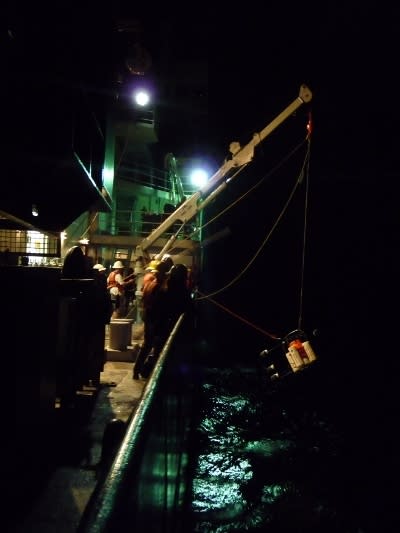
It's a familiar saying in the world of oceanography: Don't put anything over the side of the ship that you're not willing to lose.
Jenan Kharbush, a marine chemistry graduate student at the Scripps Institution of Oceanography, learned that the hard way on a recent expedition cruise to the Tonga Trench in the South Pacific when a camera and bottle collecting samples and pictures disappeared forever into the deep.
The Tonga Trench is the second-deepest trench in the world, reaching 35,700 feet (about 10,900 meters) at its deepest point. (The Mariana Trench off the coast of Guam is the deepest trench in the world, measured 35,756 feet (10,890 m) at its deepest point.)
"It's hard to get your head around that depth — that's the same distance from sea level that planes fly," Kharbush told OurAmazingPlanet.
The mission aimed to explore the ecosystem that exists in the trench under intense pressures and at low temperatures, particularly to gain some understanding of the microbial world of the deep. [Strangest Places Where Life Is Found on Earth]
"We understand very little about microbes' role in cycling nutrients and carbon in the ocean," Kharbush said. "We are still trying to understand how microbes take stuff in and recycle it or export carbon to the deep ocean — something that's important in today's world as carbon in the atmosphere increases."
Other people on the expedition were interested in finding out more about the physiological adaptations that microbes use to live in such a harsh environment.
Data from the deep
Unlike many oceanographic ventures, the student-scientists had just a few days to do their work. The whole trip lasted just six days — one to cruise from Apia, Samoa, to the ocean over the trench, three to do all their research, and two to continue on to Fiji, where they disembarked the vessel Revelle. The cruise took about 40 people, half of them scientists.
Once over the trench, the science team worked around the clock to get their samples and data from the depths where the water was a frosty 34 degrees Fahrenheit (1.1 degrees Celsius) — close to freezing. Normally, oceanographers put something on a wire and lower it down to gather water samples, but the depths of the trench made this impossible — there's no wire 30,000 feet (9,000 m) long. So the team used a deep-sea camera with bottles attached that sunk itself to the bottom, gathered pictures and samples, then closed the bottles and released its ballast weights to rise up again.
The whole system went down three times for about 8 hours and was programmed ahead of time, Kharbush said. When the camera popped up, the scientists looked all around the ship but it was a challenge to find the small instrument in 15-foot (4.5 m) waves. The instrument has a radio transmitter, but the ship — a giant hunk of metal — interfered with the signal.
Fortunately, the team was able to retrieve the bottles and camera each time – until the final sample. They had baited the bottles, hoping to get better pictures and samples of creatures in the deep. The bottles and camera never returned to the surface on the last try and probably collapsed under the pressure, Kharbush said.
"The bottles have a limit for how long they can withstand that pressure," she said. "It's a real bummer because that last deployment would have provided the most interesting footage and samples."
All is not lost, though: The team gathered data from the other three deployments, and other science experiments were done on the ship, including one that recorded ambient sound in the deep ocean and another that brought back 5-foot (1.5 m) cores of mud from 30,000 feet.
Not a day at the beach
The cores and water samples had to immediately be stored at pressures equivalent to the deep sea, and at fridgelike temperatures to keep the microbes intact and alive to be studied.
"You can't take stuff like that back on the airplane," Kharbush said. "There's just not enough dry ice around to keep it cold, so it comes back with the ship." Once the samples return to the lab at Scripps, the team will start to poke around in the water column and sediment to see what microorganisms might be dwelling there.
Kharbush said that when she talks about the scientific voyages, her friends and family sometimes imagine a poolside margarita instead of days and nights of intense work.
"When I tell people I'm going on a cruise, they think it's a floating island and it's relaxing and fun," she said. "It still is fun, but people have no idea that we're working for 24 hours per day and it's intense."
Copyright 2012 OurAmazingPlanet, a TechMediaNetwork company. All rights reserved. This material may not be published, broadcast, rewritten or redistributed.
