
EU leaders agree to $1.28 trillion 7-year budget
European leaders agree to significantly pared-back $1.28 trillion 7-year budget
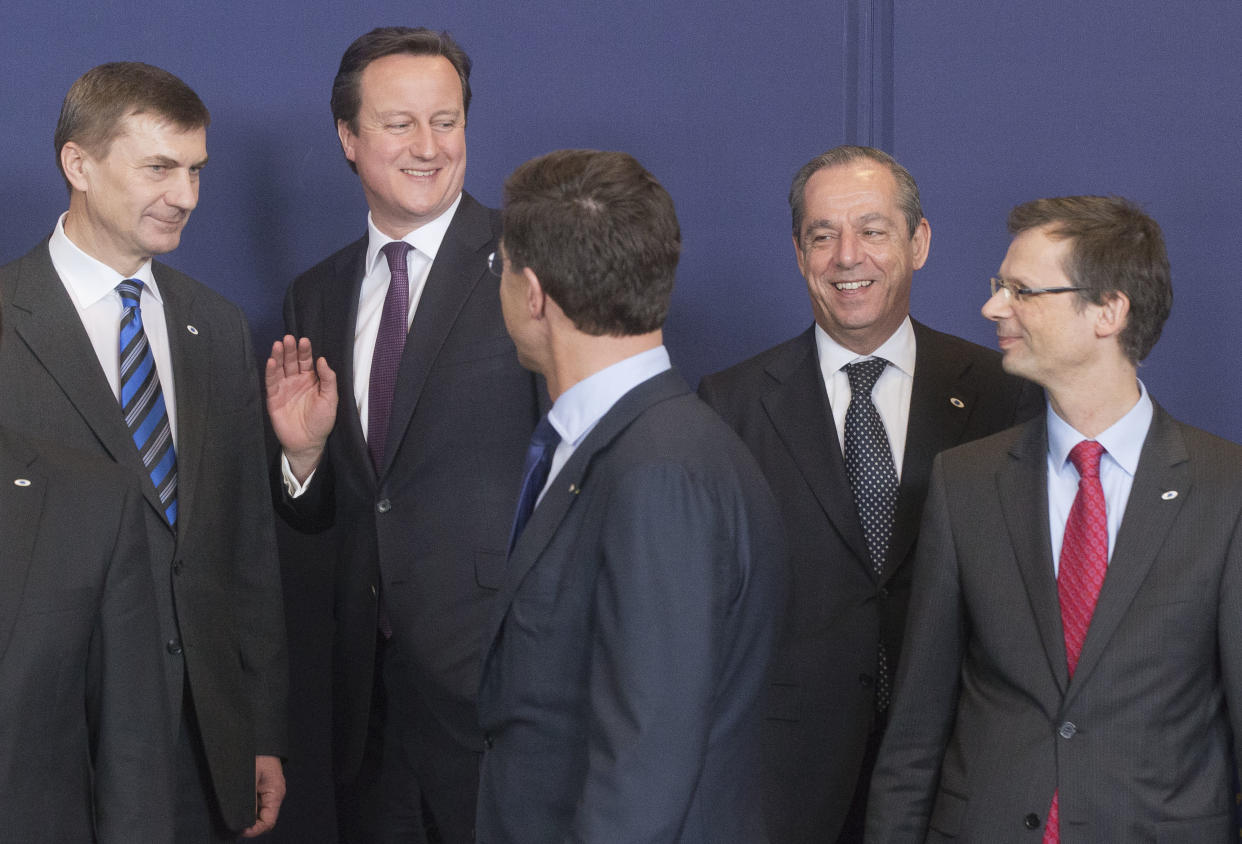
From left, Estonia's Prime Minister Andrus Ansip, British Prime Minister David Cameron, Dutch Prime Minister Mark Rutte, Malta's Prime Minister Lawrence Gonzi and Secretary General of the Council Uwe Crsepius during a group photo at a EU Budget summit at the European Council building in Brussels, Thursday, Feb. 7, 2013. European Union leaders drew hard lines Thursday ahead of a struggle over EU spending for the next seven years that reflects deep divisions about the role of their union. (AP Photo/Michel Euler)
BRUSSELS (AP) -- European Union leaders agreed Friday to a significantly reduced 7-year budget worth €960 billion ($1.28 trillion) — the first cut in spending in the 27-country group's history.
European Council President Herman Van Rompuy announced that the agreement had been reached after two days of nearly round-the-clock negotiations — the longest negotiations of his tenure in office. The final total was about 40 billion less than the European Commission had originally proposed.
The issue of what to give to the EU was made more difficult because, he said, its members were struggling with poor economic growth and harsh austerity measures.
"We simply could not ignore the extremely difficult economic realities across Europe," Van Rompuy told reporters. "It had to be a leaner budget."
He said it would amount to 1 percent of the European Union's gross national income.
The final number was far less than the €1.03 trillion ($1.38 trillion) the EU's executive arm, the European Commission, had originally proposed. The €959.988 billion total will cover the years 2014-2020; the budget for the years 2007-2013 was €975.777 billion.
The two-day fight over the cap on what the EU can spend on everything from infrastructure to development aid laid bare divisions over what the role of the union should be.
"The effort was worth it," said German Chancellor Angela Merkel. "The agreement is good and important," she added, saying it would show solidarity and ensure predictability.
The European Parliament must still approve the deal — and lawmakers there suggested that the drastic cuts proposed would be unacceptable.
"This agreement will not strengthen the competitiveness of the European economy but weaken it," said a statement by the leaders of the four largest political groups in the Parliament. "It is not in the prime interest of our European citizens."
The proposed budget has also been criticized for cutting too deeply into aid for poor countries and other programs critical for Europe.
At its heart, the hard-fought summit in Brussels was a tussle about what the 27-nation European Union stood for: some leaders argued it was a drag on national budgets in tough economic times, while others said the economic crisis highlighted the need for closer and deeper ties, which would compel the EU to do more than in the past.
The deal that emerged seemed to lean more toward the position of countries led by Britain, which insisted that the EU couldn't look for more money at a time of belt-tightening across Europe.
"The UK public can be proud that we cut the 'credit card level' for the first time ever," said British Prime Minister David Cameron. "I wanted a cut. That is what I achieved today. Working with allies, this is a great deal for Britain and a great deal for Europe. And a great deal for European taxpayers."
Indeed, it seemed a loss for many of the newer — and generally poorer — members, who see Europe as a club that is only as strong as its weakest member. That group, led by Poland and France, argued that Europe meant nothing if the budget were not used to bridge the wealth gap between rich and poor members and help restart growth.
But French President Francois Hollande also claimed victory, taking a small dig at Britain by noting that Cameron had moved farther from his government's desired budget total than France had. More broadly, he sought to paint the agreement as a win for Europe, calling it a grand compromise that safeguarded important shared programs and values.
"If there was a loser, he could have blocked it," Hollande said, referring to the fact that each of the 27 countries had the right to veto any agreement.
Both sides had threatened to walk away from the table — again — if they didn't get what they wanted. The first summit to negotiate a budget collapsed in November.
Beyond the deeper philosophical differences, there were national concerns that made the negotiations particularly long and difficult. Dutch Prime Minister Mark Rutte, for example, had pledged to maintain his country's discount in the amount it pays to the EU — a €1 billion discount — and said he fought to achieve that, successfully, right up to the last minute.
Despite criticism of the cuts, Van Rompuy noted that the proposed budget did put aside €6 billion ($8.02 billion) to help alleviate youth unemployment, which has skyrocketed because of the economic crisis over the past few years, notably in Greece and Spain. He also said it included real increases for programs to foster education, growth and innovation.
The EU, with a population of more than 500 million people and an annual gross domestic product of €12 trillion ($16.05 trillion), is the world's largest economy.
But the EU's budget for 2012 is €147.2 billion ($196.87 billion) — less than one-fifth the size of the budget of the U.K. alone.
Separate from the national budgets, it is designed in part to balance out the economic development of EU members by injecting funding into poorer countries. The EU has funded hundreds of thousands of infrastructure and capital projects over the years, from the installation of broadband network to upgrading road networks.
The EU budget includes, as well, items meant to generate economic growth in the future, such as research and development, increasing digitalization and creating a new, more accurate satellite navigation system. It also funds regulation and administration in such areas as mergers and competition, the review of national budgets to ensure they do not include excessive deficits and banking supervision.
___
Raf Casert contributed to this report.
___
Follow us on Twitter: http://www.twitter.com/rcasert, http://www.twitter.com/Don_Melvin, http://www.twitter.com/sdilorenzo.

