Europe Tackling Big Space Projects in 2013


LONDON — The European Space Agency has some ambitious resolutions for the New Year. The year 2013 will include the agency’s first spaceflight for its newest class of astronauts, the launch of its latest robot cargo ship Albert Einstein, and the development of new rockets and spacecraft, including a reusable space plane and work on NASA’s new Orion spacecraft.
January and February should see agreements and contracts signed for the new rockets, Ariane 5 Mid-Life Evolution (ME) and Ariane 6, and for ESA’s participation in NASA’sOrion space capsule. ESA is providing the service module for the Orion capsule, which NASA plans to use to fly astronauts on future deep-space missions.
With deadlines in 2014 for the rocket work, and 2017 for an unmanned Orion test flight, ESA officials know 2013 will see lots of activity right from the start.
“The Orion service module funding has been approved, so now the usual work process starts. I think [the NASA-ESA agreement signing] is in January. It should be rather early from what I’ve heard, it is something to be done towards the beginning of the year,” Franco Bonacina, spokesman for ESA’s director-general, Jean-Jacques Dordain, told SPACE.com. [Meet the European Space Agency (Video)]
Powerhouse for NASA’s Orion
ESA will provide one service module for Orion’s 2017 test launch. The module’s preliminary design review, or PDR, is planned for July 2013. The PDR is a major milestone for spaceflight projects, allowing managers to check a spacecraft's design progress.
The ESA service module’s previous review, the system design review, occurred in September 2012, and the next major design review is not until 2015. The service module will provide propulsion, avionics, heat control and energy from solar arrays. It will also store water, oxygen and nitrogen for life support.
ESA’s Orion module is being delivered as an in-kind contribution for International Space Station (ISS) operations, for the period 2017 to 2020. The module is expected to cost ESA several hundred million dollars.
Europe’s new rockets
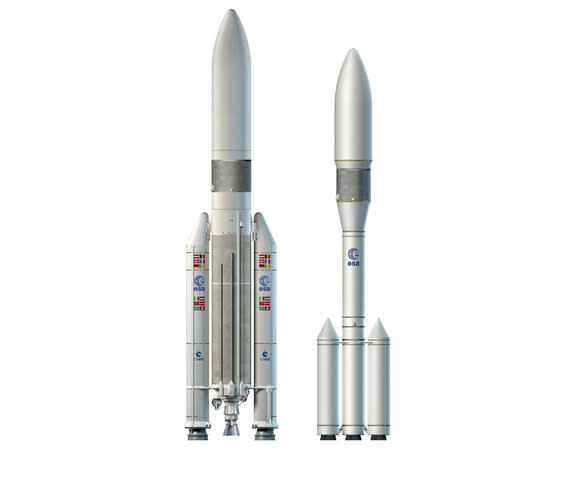
Before the Orion work shifts into gear, a pair of two-year studies is due to begin at the start of 2013 for the agency’s Ariane 5ME and Ariane 6 rockets. This is so ESA can make a decision about the future of its launchers in late 2014.
Operated by the company Arianespace, the workhorse Ariane 5 rocket launches ESA missions and commercial satellites. The rocket launches from the South American territory of French Guiana and is able to launch two spacecraft at a time. It first flew in 1997 and can launch up to 22,000 pounds (10,000 kilograms) into orbit.
The new Ariane 5 version, the Ariane 5ME, has already been in development for many years and it had been planned to be operational from 2016. It will be the same height, excluding the nose cone, and weight as its predecessor, but will be able launch an additional 2,540 pounds (1152 kg) of payload, with a maximum payload of 24,640 pounds (11,176 kg) for geostationary orbits.
The Ariane 5ME will use a new upper stage and rocket engine, the Vinci, and has a larger nose cone. If approved in 2014, the Ariane 5ME could be operational towards the end of this decade.
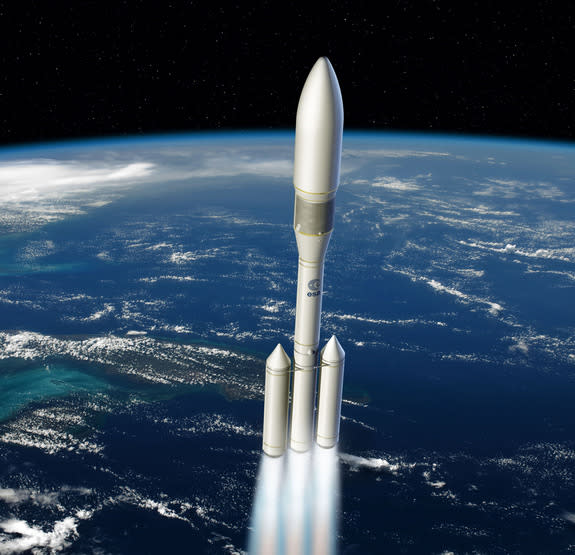
However, ESA has concluded that it needs a simpler rocket that can launch more frequently with only one payload onboard. This is the planned Ariane 6, which was originally called Next Generation Launcher (NGL).
The Ariane 6 rocket has been the subject of numerous studies that have evaluated NGL versions that either only have solid rocket motors or only liquid fuel engines. According to Bonacina, for Ariane 6, the two year studies will determine, “what shape and configuration it will have and what kind of money will be needed over what timeframe”. Neither Ariane 5ME nor Ariane 6 will launch astronauts.
A decision on Ariane 6 was supposed to take place in 2012, but disagreement between France and Germany, the largest ESA budget contributors, saw a compromise. France was in favor of Ariane 6, while Germany wanted Ariane 5ME to go ahead.
“It was a heavy compromise between Germany and France. They all had their interesting points of view and a solution has been found,” Bonacina said. “The good thing is that Ariane 6 has started and Ariane 5ME continues in parallel.”
In April of this year, ESA expects to hit two rocket milestones. They include second launch of its latest rocket, Vega, which uses solid rocket motors for its first, second and upper stages. The Vega rocket will launch the Earth observation satellite, Proba-V. The V in Proba-V stands for vegetation because the satellite will monitor the Earth’s plant life. [Europe’s Vega Rocket 1st Launch (Photos)]
Then in mid or late April, the latest version of the Ariane 5 — the Ariane 5 ES — is due make its next launch. The Ariane 5 ES has an upper stage whose engine can reignite. This allows it to launch ESA’s robotic Automated Transfer Vehicle cargo ships.
Europe’s ATV spacecraft deliver supplies to the International Space Station and propellant to raise the station’s orbit when needed. The ATV to be launched in April, called Albert Einstein, will be the fourth ESA’s five planned ATV missions to the space station.
Satellites galore
Europe’s other launches in the second half of 2013 include satellites for the European Union’s space-based navigation system, Galileo. The Galileo satellites will be launched by a Russian Soyuz 2 rocket from the Soyuz launch site in French Guiana.
Also launched in the latter half of 2013 by Soyuz rockets will be ESA’s Gaia mission and the Sentinel-1A satellite. The Gaia spacecraft will operate beyond the Moon, over 600,000 miles (965,606 kilometers) from Earth, and its goal is to create the largest and most precise three-dimensional map of the galaxy.
The Sentinel-1A is a polar orbit satellite that uses synthetic aperture radar. It is the first dedicated satellite for the Global Monitoring for Environment and Security constellation, a joint venture between ESA and the European Union. A constellation of two satellites, GMES’ Sentinel-1B is expected to launch in 2015.
An Ariane 5 will also launch Alphasat this year. This high bandwidth telecommunications satellite will provide commercial services and test various communications technologies including lasers.
Europe’s astronauts and robot arm
In May, a Russian Soyuz spacecraft will launch ESA’s Italian born astronaut Luca Parmitano from Baikonur Cosmodrome in Kazakhstan. Parmitano is launching on a six-month mission to the International Space Station and is slated to return to Earth in November.
Parmitano was selected to join ESA’s astronaut corps in May 2009 as one of six candidates. The five others hailed from France, Germany, Italy, Denmark and the United Kingdom. Of those, Parmitano is the first bound for the space station.
The 35-year old former Italian Air Force test pilot will be a flight engineer on the station crew. While Albert Einstein and Parmitano are headed to the orbiting laboratory in 2013, a new robotic arm for the orbiting laboratory will likely slip to 2014.
The station’s new European Robotic Arm, or ERA, will launch on a Proton rocket from Baikonur Cosmodrome, ESA’s ERA will be attached to Russia’s multipurpose laboratory module.
The robotic arm consists of two end-effectors, two wrists, two limbs and one elbow joint, together with electronics and cameras. Both end-effectors act as either a hand or the base from which it can operate. ERA will be used in the assembly and servicing of the Russian segment of the station, and its infrared cameras will allow it to carry out inspections of the station’s exterior.
The arm will also be able to transport astronauts, like a cherry picker crane, from one external location to another. This saves time and effort during spacewalk activities. ERA is also compatible with the new Russian airlock, so it can transfer small payloads between the station’s interior and the vacuum of space quickly. This will also reduce the crew’s space walk set-up time and allow ERA to work with astronauts outside the station.
Space plane under development
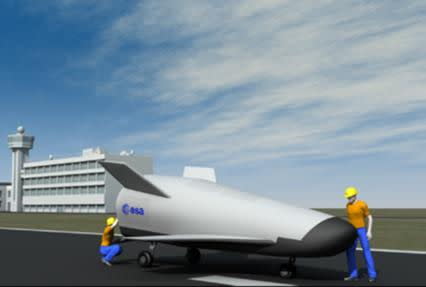
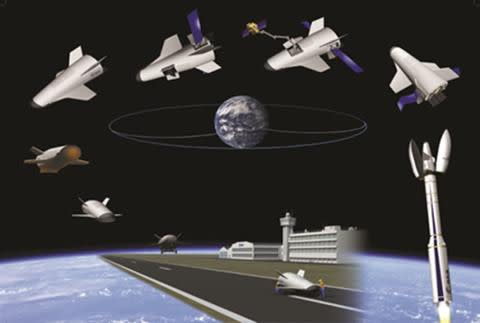
Like ERA, ESA’s space plane prototype, the Intermediate Experimental Vehicle (IXV), was to have been launched in 2013. It will now fly on ESA’s Vega rocket in 2014. The IXV vehicle is designed to test re-entry technologies during a suborbital flight launching from French Guiana and splashing down in the Pacific Ocean using parachutes.
ESA has now approved funds for IXV’s possible follow-on, Innovative Space Vehicle (ISV), under the Program for Reusable In-orbit Demonstrator in Europe.
The ISV would be Europe's civilian equivalent of the U.S. Air Force's unmanned X-37B Orbital Test Vehicle, a robotic miniature space shuttle that has flown on three missions since 2010. The unmanned European space plane would be much smaller than the Air Force vehicle, however.
Giorgio Tumino, IXV program manager told SPACE.com: “We did not get all what we asked, but enough to go ahead and keep the planning.”
Follow SPACE.com @Spacedotcom. We're also on Facebook and Google+.
Copyright 2013 SPACE.com, a TechMediaNetwork company. All rights reserved. This material may not be published, broadcast, rewritten or redistributed.
