Famous Mars Meteorite's 'Fossils': What Arctic Rocks Can Tell Us
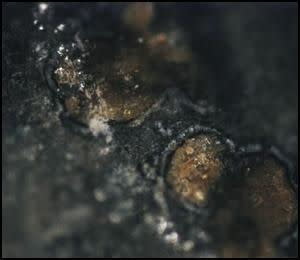
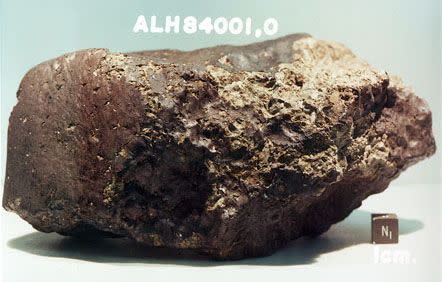
In 1996, a research group led by Dave McKay of NASA’s Johnson Space Center claimed to have found evidence of fossilized life in a Mars meteorite known as Allan Hills 84001.
Not only did the shapes look like bacteria, but a form of magnetite (iron oxide) was found in the meteorite that, on Earth, is produced within the bodies of certain bacteria. The study also found tiny carbonate globules in the meteorite, which the scientists said were likely formed by living organisms in the presence of liquid water.
Since their surprising announcement, other scientists have closely examined the Allan Hills meteorite and concluded the microscopic shapes aren’t necessarily associated with life, and the different features in the meteorite all could have formed by non-biological processes.
Scientists studying the rocks of the arctic archipelago of Svalbard later found carbonate globule structures like those in the Allan Hills meteorite. Rather than being formed by life, the Svalbard structures formed when the Sverrefjell volcano erupted about a million years ago, forcing magma up through an overlying glacier. [5 Bold Claims of Alien Life]
A group at the Carnegie Institution of Washington used a Ramen spectrometer to compare abiotic Svalbard carbonate globules with those found in ALH 84001, and found a high degree of similarity.
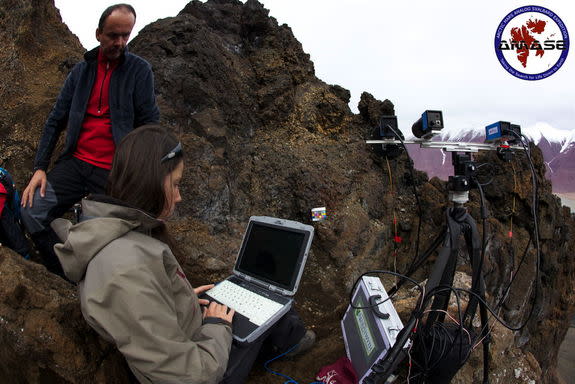
Hans Amundsen runs the Mars analogue project AMASE (Arctic Mars Analogue Svalbard Expedition) and has been visiting Svalbard every summer for the last decade to investigate the many ways it resembles Mars. Astrobiology Magazine editor Leslie Mullen recently sat down with him at the Third Conference on Terrestrial Mars Analogues in Marrakech, Morocco, to discuss what the Svalbard rocks tell us about the still-controversial Mars meteorite.
Q: Could you tell me about the rocks in Svalbard that are analogous with the ALH 84001 Mars meteorite?
Hans Amundsen: They have the same strange carbonate minerals as the Allan Hills meteorite.
Q: The same structures that were previously thought to be fossilized life?
Amundsen: Well, yes, McKay speculated that these spheres were some sort of indication of a bio-pattern or bio-shape. I don’t know anyone who still believes that. But the shapes we see in the Svalbard rocks are identical to the ones in the Allan Hills meteorite.
Q: Identical in shape, and chemically?
Amundsen: Both.
Q: I was at a meeting a few years ago where they were still debating whether the ALH 84001 features were biological. One line of evidence they used to argue for life were the magnetic crystals they found in the meteorite.
Amundsen: Ok, yeah. The Allan Hills carbonates contain a particular type of iron oxide of magnetite with crystal morphologies that apparently are similar to what you find in microbes with these things. Some microbes use magnetite as a compass needle to navigate in the Earth’s magnetic field, so it knows when it’s swimming up and when it’s swimming down. But to my knowledge, those morphologies are not unique to bugs.
Q: Do you find them in rocks generally?
Amundsen: Not generally, but you find magnetites of all sorts of morphologies. I guess the basic point is that the McKay group had a set of observations that could be interpreted as biogenic in origin, but if you do your homework there are lots of different ways of interpreting those features. Like those carbonate spheres. If you deposit carbonate in still-standing water, it will form spheres. [7 Biggest Mysteries of Mars]
Q: In any environment?
Amundsen: It’s simply because the carbonate building blocks, they sort of migrate randomly in the liquid, and then suddenly one sticks. And once one has made a nucleus, the others will form on it and it will grow —it receives building blocks from around it and it just grows.
You know the gem called malachite? Malachite is an example of a very similar texture, where you have these cauliflower bulbous things. Malachite forms in the same way, in water with malachite building blocks, obviously, and it just nucleates and it forms a cauliflower accumulation, like the carbonates in the Allan Hills meteorite. Quite a few carbonates elsewhere form like that, from many different types of fluids.
Q: So could you describe the soils you were studying and how they formed?
Amundsen: They’re not really soils; it’s ice in rocks. In Svalbard, there were some volcanoes that erupted through a thick ice layer; it was maybe up to a kilometer thick. During that time it was extremely cold up there, more like Antarctica. So the volcanoes melted the ice and they became soaking wet.
At some stage you turn the heat off, the volcanic activity stops. And because it was still extremely cold, the wet volcanoes froze. By that time the glacial melt water that had been sitting in basalt acquired some of the magnesium and calcium from the basalt, and when it froze it had to get rid of its CO2 and calcium and magnesium and it made carbonates.
So it’s very similar to what happens with evaporites — you just keep removing water until your remaining fluid becomes so concentrated with whatever is left over that it starts to form minerals. And evaporation and freezing do pretty much the same thing — you simply remove H2O as vapor or ice.
Q: Was your study implying that Mars was never warm?
Amundsen: It doesn’t show that Mars was never warm, but it certainly indicates that you can make minerals like in the Allan Hills meteorite under low temperature conditions, possibly during freezing or close to zero degrees [Celsius]. A study published last year by a CalTech group found that the Allan Hills carbonates formed at about 20 degrees Celsius.
Q: Meaning they formed in that temperature.
Amundsen: Yeah. The Svalbard ones, we don’t know. But the oxygen isotopes suggests it was very cold. But we can’t tell if it was zero or minus 30, because we don’t know the exact composition of the waters.
If you have the water and the carbonate that formed, you can estimate the temperature. But we only have the carbonate; the water is gone. But the only other carbonates on Earth that look similar to the Svalbard ones have formed during freezing of water in caves.
There’s examples from Arctic Canada and from Poland where there are these very unusual, very light oxygen isotopes. And the whole setting of the Svalbard volcanoes — they probably erupted under extremely cold climatic conditions, melted the ice and then froze again. So you can’t use the Allan Hills carbonates to argue for anything warm. But it was certainly wet. [Photos: The Search for Water on Mars]
Q: Volcanoes are warm, but I guess they are hot spots in a cold place.
Amundsen: Yeah, there’s been volcanism on Mars throughout its history, of course. But as a surface condition, you get essentially the same carbonates and sulfates forming under permafrost conditions as you do under tropical conditions. They don’t look different.
Q: And there’s nothing about the heat caused by being blasted off the surface that had anything to do with that?
Amundsen: No, I think there could be. The Allan Hills meteorite likely witnessed several blasts nearby before it was kicked out itself. So you could have had warm events triggered by impacts.
So you warm the top layer of the crust, and what maybe was permafrost then melted and froze back again. And we don’t know how deep the Alan Hills meteorite originally came from. Most people are thinking of it as sitting on the surface, but it could have been hundreds of meters subsurface, and was excavated by the impact.
You know from the shocked minerals from the Allan Hills meteorite that there were impacts going on. The age of the Hills meteorite was at a time when there were lots of impacts. But you can’t preclude that there was lukewarm water drizzling down from above.
Q: It’s all very interesting how the questions on the meteorite structures still aren’t completely settled.
Amundsen: In science there’s always a debate going on, but with the search for life on Mars I think it’s important to be conservative. If you can explain your observations with purely physical, abiotic processes, then you can’t use it to argue that you have found life outside Earth.
This story was provided by Astrobiology Magazine, a web-based publication sponsored by the NASA astrobiology program.
Copyright 2012 SPACE.com, a TechMediaNetwork company. All rights reserved. This material may not be published, broadcast, rewritten or redistributed.
