YOUR FRIENDS' ACTIVITY

    Feline Find: How the Tabby Cat Got Its Stripes
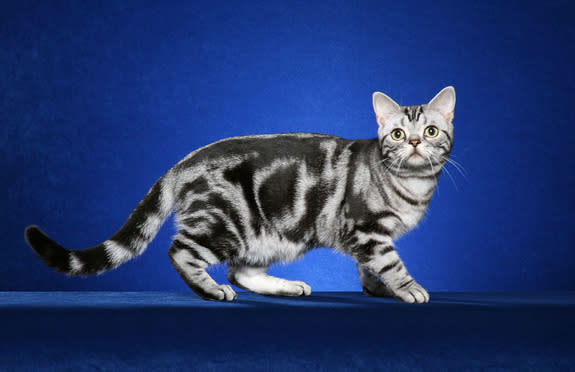
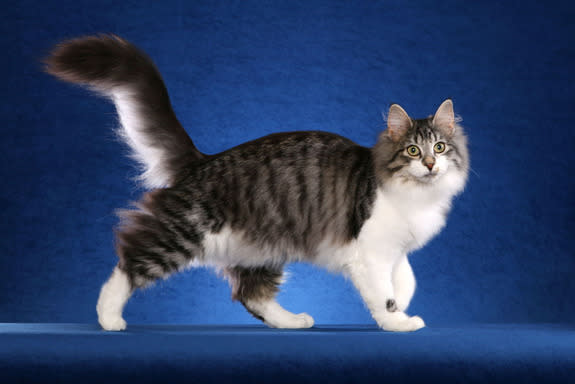
    From where does a tabby cat get its stripes? The same place cheetahs get their spots.

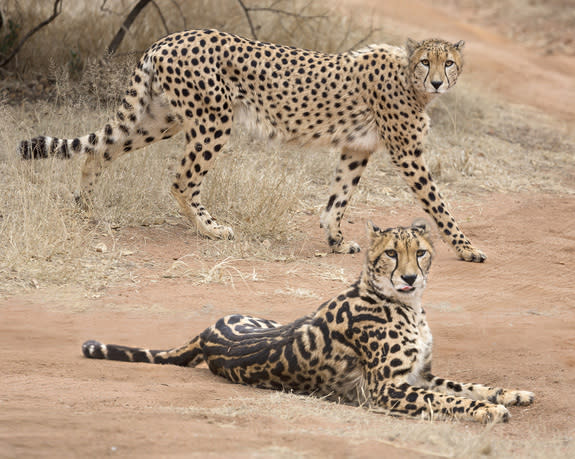
    A new study finds the same gene that is responsible for the cheetah's color patterns causes a tabby's stripes. Mutations in this newly identified gene transform a tabby's typical striped pattern into a less familiar "blotched" look. In cheetahs, similar mutations smear spots into thick stripes.

    "What this is, is the first connection of a gene involved in pattern formation in cats to their molecular status," said study researcher Stephen O'Brien of the National Laboratory for Cancer Research.

    Now "we know where the mutation is in this particular gene" to cause the pattern changes, O'Brien told LiveScience.

    Stripes or spots?

    O'Brien and his colleagues contributed to the original sequencing of the domestic cat genome, which was completed in 2007. Besides being interesting from a basic science standpoint, O'Brien said, cat genetics may help researchers understand human disease and genetic development. [The 10 Coolest Genomes Ever Sequenced]

    One mystery of cat development is how cats have come to have such varied coats, from solid colors to "mackerel" tabby patterns of thin vertical stripes. The researchers were particularly interested in what turns the mackerel pattern into a "blotched" tabby pattern, seen more often in European cats than American ones.

    A map of kitty pedigrees allowed the researchers to narrow down the genetic culprit to one region of the chromosome containing three large genes. They then sequenced the genomes of two batches of tabbies, one with blotched coats and the other striped ones, and narrowed the culprit further to a gene called Taqpep.

    Three separate mutations of the Taqpep gene in the domestic cat and another mutation in the same gene in the king cheetah can cause the tabby pattern to go from striped to splotchy, and, in the cheetah, from spotty to striped, the researchers found. This means the gene has mutated multiple times across kitties' evolutionary history.

    Cat color blueprint

    The Taqpep gene holds the blueprint for a molecule usually found on cell membranes and used for passing messages from outside the cell to the inside. A mutation of the gene causes color pattern changes by interfering with the deposition of pigment during development, O'Brien said. 

    O'Brien suspects the gene also has other functions. Membrane-communication molecules are often associated with the immune system, he said. The fact that this coat-color mutation occurred many times suggests that it may be doing something more useful for the cats than simply changing their spots and stripes. One possibility is that the genetic change influences immune function, he said, and that the coat color variations seen in cats are a side effect of that change. 

    "I think that probably there are other things to be discovered about this gene," O'Brien said.

    Follow Stephanie Pappas on Twitter @sipappas or LiveScience @livescience. We're also on Facebook Google+

    Copyright 2012 LiveScience, a TechMediaNetwork company. All rights reserved. This material may not be published, broadcast, rewritten or redistributed.
    Loading...

    More Science News

     
    • Boyfriend espaces out window as husband confronts cheating wife [VIDEO]

      As part of perhaps the most spectacular walk-of-shame ever, an underwear-clad lover escaped from a third floor bedroom as the returning husband confronted his cheating wife on a balcony.

    • Cycling-Road-Giro d'Italia classification after stage 16

      May 21 (Infostrada Sports) - Classification from Giro d'Italia after Stage 16 on Tuesday 1. Vincenzo Nibali (Italy / Astana) 67:55:36" 2. Cadel Evans (Australia / BMC Racing) +1:26" 3. Rigoberto Uran (Colombia / Team Sky) +2:46" 4. Michele Scarponi (Italy / Lampre) +3:53" 5. Przemyslaw Niemiec (Poland / Lampre) +4:13" 6. Mauro Santambrogio (Italy / Vini Fantini) +4:57" 7. Carlos Betancur (Colombia / AG2R) +5:15" 8. Rafal Majka (Poland / Saxo - Tinkoff) +5:20" 9. Benat Intxausti (Spain / Movistar) +5:47" 10. Domenico Pozzovivo (Italy / AG2R) +7:34" 11. Tanel Kangert (Estonia / Astana) +7:43" ...

    • Why We Can't Forget That Oklahoma's Senators Voted Against Sandy Relief

      Nearly four months ago, Oklahoma Senators Tom Coburn and James Inhofe both voted against H.R.152, the Disaster Relief Appropriations Act that eventually sent $50.5 billion in relief to victims of Hurricane Sandy. And in the flurry of last night's devastation in Moore, Oklahoma. it was impossible not to forget that fact, knowing the federal government would soon rally to the cause.

    • Teens Are Turning Away from Facebook Because Tumblr Is Real, and Parent-Free

      Teenagers really are over Facebook. In February the social network warned investors that "our younger users ... are aware of and actively engaging with other products and services similar to, or as a substitute for, Facebook." And in April the investment bank Piper Jaffray reported that products and services like Tumblr and Twitter were further eroding Facebook's dominance among the Justin Bieber set. But why? In a deep report published on Tuesday, Pew Research explains that teenagers departing the social network's blue confines are looking for something more... real. ...

    • Indian guest workers sue company in Miss., Texas

      Dozens of Indian guest workers are suing an Alabama-based marine and fabrication company, claiming it financially exploited them and forced them to live in squalid conditions after bringing them to work ...

    • BREAKING: Subway Just as Unhealthy as McDonald’s!

      If you watched the London Olympics last summer, you saw a parade of top athletes touting the nutritional qualities of their favorite eatery: Subway. Watching Apolo Ohno or Robert Griffin III bite into a veggie footlong with avocado or hearing that Subway is “the official training restaurant of athletes everywhere,” you might get the idea that the food served at the chain isn’t that bad for you—that it’s even healthy.

    • 18-year-old’s invention can recharge a cell phone in 30 seconds

      A teenager from Saratoga, California took home one of the top prizes at the Intel International Science and Engineering Fair late last week after showing off her invention, which can fully charge a cell phone in 30 seconds or less. Eesha Khare was given the Intel Foundation Young Scientist Award and a $50,000 prize for being runner-up in the competition, which was won by a 19-year-old who unveiled a new spin on self-driving car technology. Khare’s battery technology requires a new component to be installed inside the phone battery itself, and Intel notes that it also has potential applications for car batteries.

    Follow Yahoo! News

    Loading...