
Hidden Fingerprint of Weapons-Grade Plutonium Finally Found
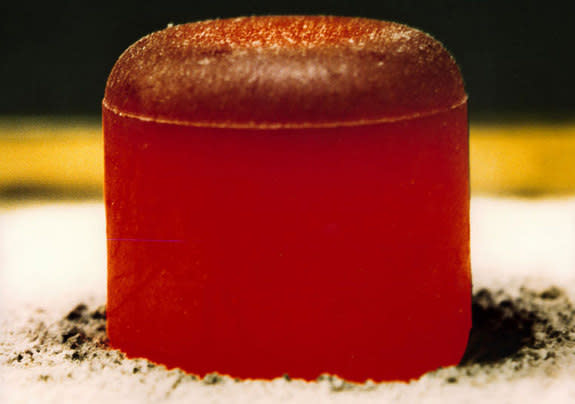
After 50 years of searching, physicists have spotted the fingerprint of radioactive plutonium, revealing the secrets of this complex molecule behind nuclear weapons.
The researchers found the "plutonium signal" using nuclear magnetic resonance spectroscopy, which is often used to peer into the electronic structure of atoms and molecules.
Their findings, detailed in the May 18 issue of the journal Science, could help scientists and others figure out the relative amounts of different types of plutonium (and its many compounds) in nuclear reactors, for instance.
"When someone has a nuclear reactor, with plutonium sitting there for a long time, you don't really know how much is in there," said study researcher Georgios Koutroulakis of the Los Alamos National Laboratory.
The researchers also suggest the findings may benefit more exotic undertakings, such as power generation for interplanetary exploration, and earthly ones, such as long-term storage of nuclear waste.
Powerful plutonium
Plutonium-239 was discovered in 1941, but its "signature" had never been seen. That meant that the way plutonium reacted with other elements around it wasn't entirely clear. When analyzing nuclear waste or fuel it's sometimes important to know, for example, how much actual plutonium there is in the sample. [Graphic - Nuclear Security: Best & Worst Countries]
Now after decades of searching, scientists working at Los Alamos National Laboratory and Japan's Advanced Science Research Center have cracked it. Koutroulakis and Hirsohi Yasuoka led a group that used plutonium dioxide cooled to near absolute zero to find the telltale signal of plutonium.
"You can probe plutonium compounds that you couldn't do before," said Thomas Albrecht-Schmitt, a professor of chemistry and biochemistry at the University
of Notre Dame, who reviewed the journal article but wasn't involved in the current study. "I saw the title of this and my jaw hit the floor; I was one of the people who wanted to do this. The really great thing here is they got it to work."
Finding a plutonium fingerprint
Nuclear magnetic resonance spectroscopy works by putting a sample in a strong magnetic field that ultimately flips the spins of charged particles in the sample. When the magnetic field is turned off the atoms "relax" and the spins start pointing in random directions again. As they relax, they give off signals that are characteristic of specific atoms.
These characteristic signals are called "chemical shifts," as the frequency shifts relative to a reference frequency. Scientists can use the known structure of one molecule to figure out the structure of other similar ones.
But plutonium is harder to measure that way. First off, plutonium-239 is hard to handle, being highly radioactive. Then there's the signal that the element gives off in the NMR machine. Plutonium's chemical shift is thousands of times larger than that of lighter elements, meaning the space you're looking in for that "spike" of radio energy is bigger. On top of that, plutonium relaxes very quickly, in just nanoseconds, when the magnetic field is shut off. For comparison, most elements relax in the space of microseconds.
To solve these problems, Yasuoka and Koutroulakis used plutonium dioxide and ran the NMR apparatus through a wide range of signal frequencies that might reveal plutonium's NMR signature. To slow the relaxation to 100 seconds, they cooled the sample to 4 degrees Kelvin — cold enough to liquefy helium.
The method could help scientists figure out how to dispose of nuclear waste, Albrecht-Schmitt said. "There's a lot of plutonium scrap, and it ages in weird ways," he said.
However, further work is needed to test the method on other plutonium compounds, though this method will make detecting plutonium much easier, the researcher said.
Copyright 2012 LiveScience, a TechMediaNetwork company. All rights reserved. This material may not be published, broadcast, rewritten or redistributed.
