YOUR FRIENDS' ACTIVITY

    Incredible NASA Photos Show Saturn's Rings and Clouds

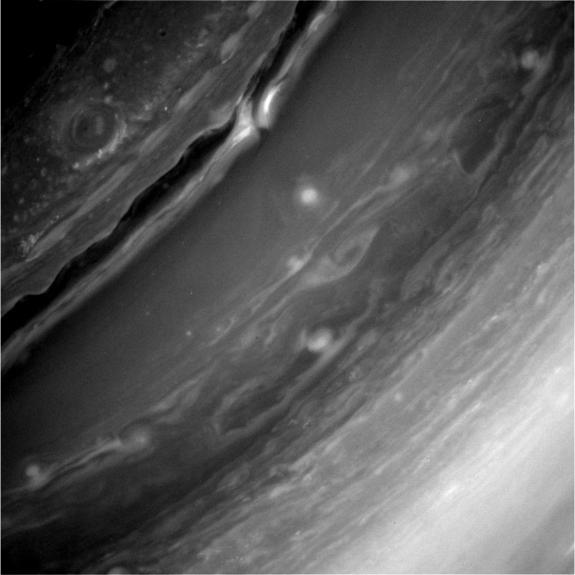
    NASA has unveiled amazing new views of the planet Saturn showcasing the ringed wonder's moons, rings and turbulent atmosphere as seen by the Cassini spacecraft.

    The first photo, which NASA released on Christmas Eve (Dec. 24), clearly shows Saturn's south pole and distinctive rings. But the image also holds a few surprises.

    The shadow of Saturn's moon Mimas appears in the photo as a small, oblique dark spot slightly to the left and above the planet's south pole. Mimas is perhaps best known for a huge crater that dominates one of its hemispheres, leading some "Star Wars" fans to compare its look to the "Death Star."

    Cassini also captured Janus, another of the more than 60 known moons of Saturn, in the top left section of the image. The small satellite is difficult to spot, but appears as a tiny white dot just over the planet's north pole. While NASA released the photo of Saturn, Mimas and Janus this week, Cassini actually snapped the image in August. Since then, mission scientists processed and polished the image to highlight its features. [Amazing Photos of Saturn's Rings]

    A second Saturn photo, a raw, unprocessed view released Wednesday (Dec. 26), shows Saturn's turbulent surface in extreme detail. Violent storms churning among Saturn's cloud tops appear as delicate whorls and swirls.

    Both of the new Saturn photos were taken with Cassini's wide-angle camera, but they represent two different ways NASA handles space images. The first photo of Saturn, Janus and Mimas was refined to bring out the most interesting aspects of the photos. For example, Janus was barely visible in the original, raw image, so image specialists opted to brighten the small moon in the final, refined image.

    The second image is part of a larger database of raw images that NASA releases online soon after they are sent to Earth by Cassini. Like the first photo, this somewhat foggy depiction of Saturn's surface will eventually be treated to bring out its most stunning aspects.

    The Cassini spacecraft has logged more than 3.8 billion miles (6.1 billion km) since its launch with the Huygens lander in 1997. Cassini arrived at Saturn in 2004 and dropped European-built Huygens onto the surface of Saturn's moon Titan. The Cassini- Huygens mission is a joint project of NASA, the Italian Space Agency and the European Space Agency.

    During its time in space, Cassini has taken more than 300,000 images of the Saturn and its moons. The spacecraft is currently in an extended phase of its mission that runs through 2017.

    Follow Miriam Kramer on Twitter @mirikramer or SPACE.com @Spacedotcom. We're also on Facebook & Google+

    Copyright 2012 SPACE.com, a TechMediaNetwork company. All rights reserved. This material may not be published, broadcast, rewritten or redistributed.
    Loading...

    More Science News

    • Soccer-Ramos shines in front of media after Mourinho no-show

      MADRID, May 16 (Reuters) - Real Madrid defender Sergio Ramos put in an assured performance in front of the cameras after coach Jose Mourinho failed to appear in Thursday's news conference ahead of the King's Cup final. Better known for his tough tackles, powerful heading ability and nerves of steel when taking penalties, the 27-year-old Spain international appeared in the conference room to represent the club and deftly handled a string of awkward questions. "If I am here it is for a reason. I can also answer questions just like the boss," Ramos said. ...

    • Bea Arthur topless painting fetches $1.9M in NYC

      A painting of actress Bea Arthur topless has sold for $1.9 million at a New York City auction. The painting is by artist John Currin and is titled "Bea Arthur Naked." It sold at Christie's auction ...

    • Cycling-Cavendish notches up 100th win, Wiggins loses time

      By Alasdair Fotheringham TREVISO, Italy, May 16 (Reuters) - Britain's Mark Cavendish racked up the 100th win of his career on stage 12 of the Giro d'Italia on Thursday but Bradley Wiggins's hopes of overall victory were in tatters when he lost time on the main bunch. Tour de France champion Wiggins, who has been suffering from a chest infection, was dropped in the final hour of the 134-km stage to Treviso after being caught on the wrong side of a split in the bunch. ...

    • Topless protest disrupts opening of Barbie house in Berlin

      BERLIN (Reuters) - Women's rights protesters disrupted the opening of a giant pink doll's house in Berlin on Thursday, saying the Barbie "Dreamhouse Experience" objectified women. Promoting the doll made by Mattel Inc, the house allows paying visitors to try on Barbie's clothes, play in her kitchen and have a go on her pink piano. The exhibition will be open until August 25. A handful of protesters gathered outside the shocking pink house that has been erected in one of central Berlin's greyest areas. ...

    • Huge Rock Crashes Into Moon, Sparks Giant Explosion

      The moon has a new hole on its surface thanks to a boulder that slammed into it in March, creating the biggest explosion scientists have seen on the moon since they started monitoring it.

    • Danish teenager makes rare Viking find

      COPENHAGEN, Denmark (AP) — Danish museum officials say that an archaeological dig last year has revealed 365 items from the Viking era, including 60 rare coins.

    • Boxing-Jones knocks out Lebedev to reclaim crown

      * Panamanian stops Lebedev in penultimate round * Povetkin knocks out Pole to set up Klitschko fight (updates with Jones win, adds details) MOSCOW, May 17 (Reuters) - Former champion Guillermo Jones of Panama stopped title holder Denis Lebedev with seconds remaining in the 11th round to reclaim his WBA cruiserweight crown from the Russian on Friday. Earlier, Alexander Povetkin knocked out previously undefeated challenger Andrzej Wawrzyk in the third round to retain his WBA heavyweight crown, setting up a long-awaited clash with super champion Vladimir Klitschko later this year. ...

    • The 16-Year-Old Who Changed Medicine Is Out to Change It Again

      At 16 years old, Jack Andraka is already a superstar in the field of science. Earlier this year, he won Intel’s prestigious Gordon E. Moore Award, when he created a groundbreaking testing method that can detect pancreatic cancer in its earliest stages. His work is expected to save thousands of lives.

    Loading...

    Follow Yahoo! News