Made-in-Space Parts Could Become Space Travel's New Norm
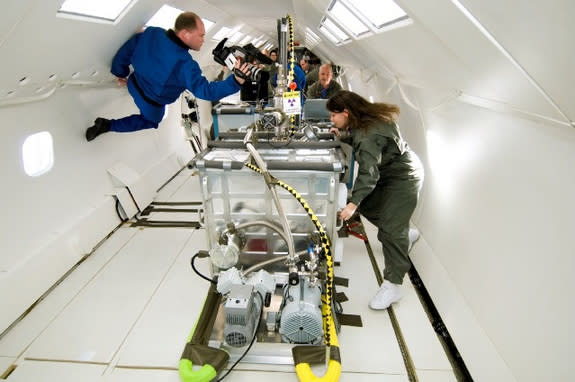


Maybe it's time to shelve the old saying, "you can't leave home without it," when it comes to packing for trips to space.
Say you're hunkered down inside Mars Base-1 and a vital piece of life-support gear breaks down. A hurried search in supply bins proves futile. The next cycler spaceship with equipment is months away. Time is running out.
This disaster scenario could be short-circuited by what's tagged as "additive manufacturing" — a process to fabricate or 3D print a critical widget layer by layer. Using additive manufacturing equipment, items can be cranked out on the spot, whether they're made of hard plastics or certain metals.
Work is now in progress to demonstrate this possibility — and the International Space Station (ISS) may be the ideal spot for perfecting the scheme. [10 Incredible 3-D Printed Products]
Cutting the umbilical
In a televised call to the space station in February, NASA chief Charles Bolden asked two onboard residents at the time, U.S. astronauts Dan Burbank and Don Pettit, to discuss what astronauts need 20 to 30 years from now, based on what they have seen and experienced in their space travels.
"Onboard space station right now, astronauts have to be essentially jacks of all trade," Burbank said. "We need to be able to fix anything and everything that happens."
As people depart from low Earth orbit, Burbank said that one of the key things needed is to essentially cut the umbilical from Earth and be able to maintain spacecraft to the degree "that if something breaks, you can replace a part outright … you need to be able to fabricate a part."
Crews can't bring along all the pieces and parts that may or may not suffer a breakdown over the course of a long mission, Burbank added.
Field center activity
NASA has a team of researchers from four different space agency centers working on demonstrating the full concept, said Karen Taminger, materials research engineer at NASA's Langley Research Center in Hampton, Va.
Taminger told SPACE.com that the research is geared toward identifying a mechanical component needing to be repaired or replaced, designing the replacement part, fabricating it — with additive manufacturing — finishing and inspecting it, and working to demonstrate remote control of the additive manufacturing process.
Currently, all of this work is being done in labs on the ground, at NASA's Langley, Glenn, Marshall and Johnson space centers, Taminger said, "but we are working towards demonstrating this capability on ISS."
Growing support
A demonstration of NASA's concept of an additive manufacturing process, Electron Beam Freeform Fabrication (EBF3), was done in simulated microgravity on parabolic aircraft flights back in 2007.
"We're now pursuing hardware and procedural changes to make the system more robust and astronaut-friendly," Taminger said.
Similarly, an enterprising team from Singularity University, a non-profit institution in California's Silicon Valley that works on forward-thinking technologies, has formed a "Made in Space" company, carrying out parabolic flights last year to showcase their 3D printing initiative.
With the National Network for Manufacturing Innovation, there has been increased national focus on 3D printing and additive manufacturing in the past six months, Taminger said. "In addition to helping create manufacturing jobs in the United States, we are pushing to demonstrate this on the ISS, in preparation for longer duration space exploration."
Although these experiments have yet to be funded or scheduled to go to the ISS, "that is certainly where we would like to go," Taminger added.
On-demand demo
Space-based, on-demand fabrication of metallic parts using additive manufacturing was outlined last month during the 1st Annual International Space Station Research & Development Conference held in Denver.
The ISS is an "ideal platform" for testing the value of on-demand additive manufacturing in the space environment, said some experts present.
According to a research paper on the initiative, the EBF3 process NASA is exploring uses an electron beam and wire to fabricate metallic structures. The process efficiencies of the electron beam and the solid wire feedstock make the EBF3 process attractive for use in space, say researchers engaged in studying the manufacturing idea.
Reducing inventory
One technology highlighted by NASA is solid freeform fabrication, a process that could be used to support fabrication and repair of large space structures, spacecraft primary structure and replacement components.
Production of replacement components by solid freeform fabrication processes during a mission could reduce or eliminate the need to carry a complete inventory of premanufactured spares. Rather, replacement components would be generated as needed from feedstock material.
As a result, only the total mass of replacements would need to be estimated instead of a prediction of which specific components might be needed. Attempting to predict which components will fail and require replacement will inherently be an inaccurate process and is likely to result in stashing away numerous components that will never be used — which is wasted mass — while "under-provisioning" other components, experts said.
"Just as Christopher Columbus brought tools with him to help explore the New World," Taminger concluded,"NASA is developing an on-demand additive manufacturing tool that will allow space explorers to build what they want, when and where they need it."
Leonard David has been reporting on the space industry for more than five decades. He is a winner of last year's National Space Club Press Award and a past editor-in-chief of the National Space Society's Ad Astra and Space World magazines. He has written for SPACE.com since 1999.
Copyright 2012 SPACE.com, a TechMediaNetwork company. All rights reserved. This material may not be published, broadcast, rewritten or redistributed.
