
Microscopic 'Bullets' Put New Armor to the Test

Lasers and microscopic "bullets" have helped test the strength of lightweight materials that can better stop gunshots than any existing armor. The testing may lead to thinner, lighter protection that makes soldiers wearing Kevlar helmets and vests look as outdated as knights in steel plate armor.
The lightweight material consists of extremely tiny glass and rubber layers that form a multilayered sandwich — each layer is measured in nanometers (one billionth of a meter) while a human hair is about 100,000 nanometers wide. Researchers fired microscopic silica glass spheres at supersonic speeds against the material so that they could figure out the best way to arrange the material's layers for the ultimate protection.
"Bottom line — we need to develop better lightweight energy-absorbing materials for soldiers and Marines and for unmanned aerial vehicles," said Edwin Thomas, a materials scientists and mechanical engineer at Rice University in Houston. "It's also relevant to the protection of satellites and the space station from micrometeorites."
Thomas previously led a National Research Council study in 2011 on how material science can improve U.S. Army technologies. That experience inspired his latest work with colleagues at Rice University, MIT, University of Bayreuth in Germany and Universite du Maine in France, which appears in the Oct. 30 issue of the journal Nature Communications.
Firing tiny bullets
The ballistics testing took a lot more preparation than just firing a bullet at a target. Researchers used a high-power laser to zap a piece of glass covered with a polymer material — creating an explosion from the other side of the glass that consisted of a gas plume followed by the microscopic silica spheres.
That first act sent the microscopic projectiles flying at supersonic speeds of up to 8,948 mph (4 kilometers per second). In the second act, the silica sphere "bullets" hit the lightweight material target made of the nanocomposite sandwich of rubber and glass layers (polystyrene-polydimethylsiloxan). [Marines' Ballistic Underwear Must Also Be Comfy]
Researchers aimed the laser and watched the results through a scanning electron microscope capable of examining objects as tiny as on the nanometer scale.
"We certainly have a unique new micro-ballistic test and the ability to study nanostructured materials at the nanoscale — an essentially unexplored area of materials research at high strains and high strain rates," Thomas told TechNewsDaily.
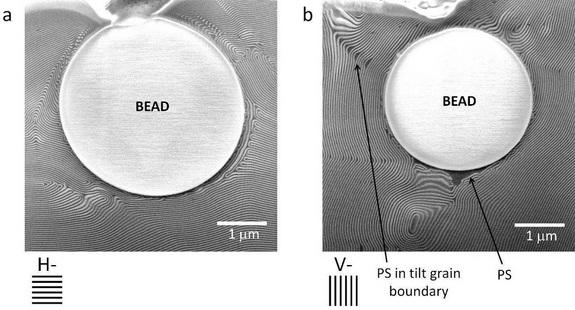
The results proved surprising in several ways. Researchers tested the ballistic impact on the lightweight material in two configurations — the material layers running parallel or perpendicular to the micro-bullet strikes — and found that the perpendicular configuration provided up to 30 percent more resistance to the projectile penetration.
That seemed to run counter to the fact that the stiffness of the material was greater in the parallel configuration. But such "counterintuitive" findings are what make such studies so interesting, Thomas said.
Mysterious melting
Another surprise came from how the "bullet" penetration appeared to melt the rubber and glass layers, causing them to intermix. That could only have happened if the energy from the impact mysteriously raised the material temperature above 5,432 degrees F (3,000 degrees C) — the point at which the material changes from a solid to liquid phase.
"It is often when you first get a glimpse of new phenomena that you can imagine way more questions than there are initial answers," Thomas said.
That remains one of many mysteries for the researchers to explore in future studies. But they also have an eye on translating their results into better lightweight materials for shielding jet engines and protecting spacecraft from space debris.
"The biggest market is likely to be turbine blades and protection against erosion," Thomas said. "There are lots of turbine engines out there, and lengthening the time between the replacements of the blades would save a lot of money. Military and NASA applications are also very important, but not as large a market."
This story was provided by TechNewsDaily, a sister site to LiveScience. You can follow TechNewsDaily Senior Writer Jeremy Hsu on Twitter @jeremyhsu. Follow TechNewsDaily on Twitter @TechNewsDaily, or on Facebook.
Copyright 2012 LiveScience, a TechMediaNetwork company. All rights reserved. This material may not be published, broadcast, rewritten or redistributed.