YOUR FRIENDS' ACTIVITY

    Near-Earth Asteroid Loses Its Magnetic Mojo
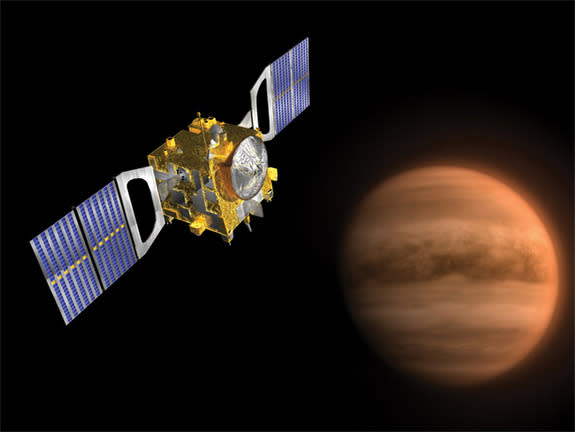
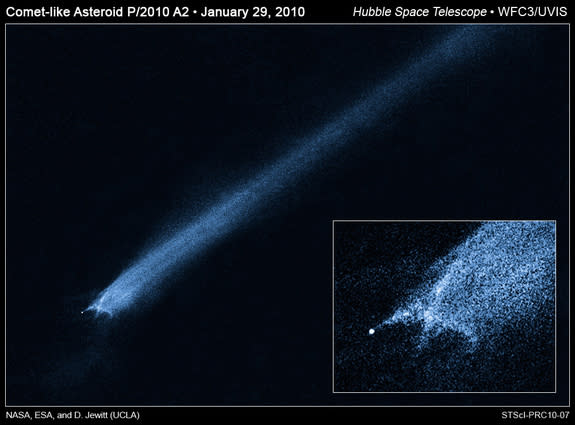
    An asteroid that zooms inside the orbit of Venus has lost its magnetic mojo, perhaps after clearing out the debris along its orbital path, a new study reports.

    Three decades ago, NASA's Venus Pioneer Orbiter noticed that the near-Earth asteroid 2201 Oljato caused a flurry of magnetic activity whenever it arrived inside Venus' orbit. But more recent observations by the European Space Agency's Venus Express probe don't pick up the odd phenemonon, researchers said.

    Oljato orbits the sun every 3.2 years. The Venus Pioneer Orbiter saw the 1.1-mile-wide (1.8 kilometers) space rock dip between Venus and our star three times during the spacecraft's operational life, which lasted from 1978 to 1992.

    All three times, the probe detected a roughly threefold increase of unusual magnetic peaks known as Interplanetary Field Enhancements (IFEs), both ahead of and behind the asteroid. But things had changed by the time Venus Express arrived at Earth's hellishly hot sister planet in 2006.

    "In more recent observations with Venus Express, the occurrence of IFEs is now lower than the average we find outside this region," study leader Christopher Russell of UCLA said in a statement.

    Russell and his team think the answer to this riddle lies in a reduction of the debris that once clogged Oljato's orbital path.

    "At one point in time Oljato shed boulders – mostly a few tens of meters in diameter – into its orbit and they formed a debris trail in front and behind Oljato," Russell said. "These impactors then hit other targets as they passed between Venus and the sun. The large amount of fine dust released by these collisions was picked up by the solar wind, producing the IFEs observed by Pioneer, and was accelerated out of the solar system." 

    The reduced rate of IFEs measured by Venus Express suggests that such collisions have helped sweep Oljato's orbit clean and reduced the asteroid's co-orbiting debris cloud, researchers said.

    "The IFEs observed by Pioneer suggest that more than 3 tons of dust was being lost from the region each day," Russell said. "Effects associated with solar heating and gravitational perturbations have gradually nudged larger chunks of debris away from Oljato's orbit. From once being unusually crowded, the region has become unusually clear and free of IFEs."

    Russell presented his team's explanation for Oljato’s strange behavior in September at the European Planetary Science Congress in Madrid.

    Follow SPACE.com on Twitter @Spacedotcom. We're also on Facebook & Google+.

    Copyright 2012 SPACE.com, a TechMediaNetwork company. All rights reserved. This material may not be published, broadcast, rewritten or redistributed.
    Loading...
    • Even Cavendish surprised by fourth stage win

      By Alasdair and Fotheringham CHERASCO, Italy, May 17 - A series of small but challenging climbs late on Friday's stage of the 2012 Giro d'Italia could not stop Britain's Mark Cavendish taking his fourth stage win and second in two days. Italy's Vincenzo Nibali remained overall leader but it was sprinter Cavendish who stole the show again after compatriot and pre-race favorite Bradley Wiggins failed to start the 254 kilometer stage, the longest in this year's Giro. In a bunch sprint finish Cavendish outgunned Italy's Giacomo Nizzolo and Slovenia's Luka Mezgec. ...

    • NYers furious over photos taken through windows

      In one photo, a woman is on all fours, presumably picking something up, her posterior pressed against a glass window. Another photo shows a couple in bathrobes, their feet touching beneath a table. And ...

    • Bea Arthur topless painting fetches $1.9M in NYC

      A painting of actress Bea Arthur topless has sold for $1.9 million at a New York City auction. The painting is by artist John Currin and is titled "Bea Arthur Naked." It sold at Christie's auction ...

    • This Child Made a Film About His School Lunch—and He Titled It ‘Yuck.’ (VIDEO)

      When fourth grader Zachary Maxwell started nagging his parents to let him bring his own lunch to school, they knew something was up. Zachary was served lunch every day in his New York City public school and because it was a hot lunch, his parents were insistent he take advantage of it.

    • Alaska volcano shoots lava up hundreds of feet

      Alaska's remote Pavlof Volcano was shooting lava hundreds of feet into the air, but its ash plume was thinning Saturday and no longer making it dangerous for airplanes to fly nearby.

    • Horseracing-2013 Preakness Stakes result

      May 18 (Reuters) - Result and finishing order of the 2013 Preakness Stakes at Pimlico racecourse on Saturday. 1. Oxbow (Gary Stevens) 2. Itsmyluckyday (John Velazquez) 3. Mylute (Rosie Napravnik) 4. Orb (Joel Rosario) 5. Goldencents (Kevin Krigger) 6. Departing (Brian Hernandez) 7. Will Take Charge (Mike Smith) 8. Govenor Charlie (Martin Garcia) 9. Titletown Five (Julien Leparoux) Winner trained by: D. Wayne Lukas Winner paid $32.80 for a $2 win bet Winning margin: 1-3/4 lengths Time: one minute 57.54 seconds (Compiled by Steve Ginsburg; Editing by Greg Stutchbury)

    • A record Powerball jackpot isn't a record to celebrate

      When the 43-state Powerball lottery jackpot hit a record at $600 million Friday, many Americans who would otherwise not gamble rushed out to buy the $2 tickets. “Just on the off-chance,” many probably said.

    Loading...

    Follow Yahoo! News