
Obama's health care law: A trek, not a sprint
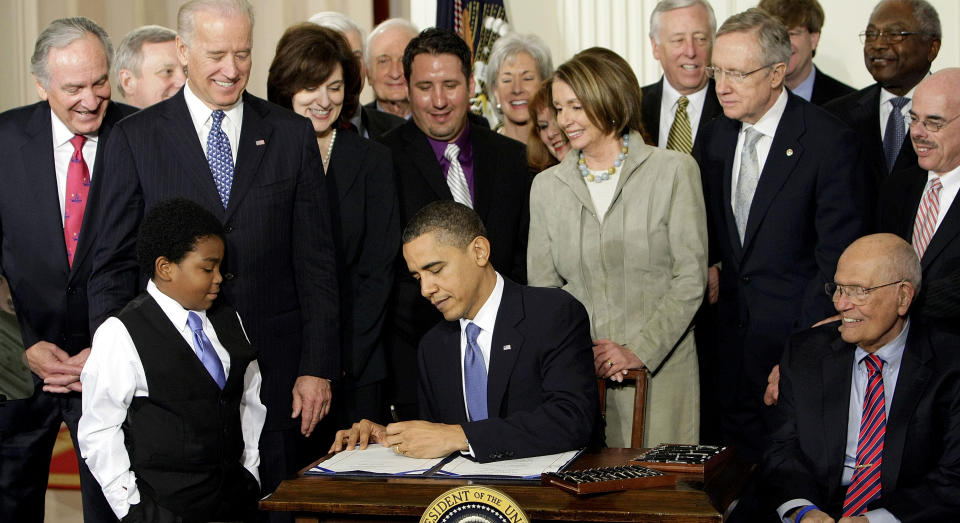
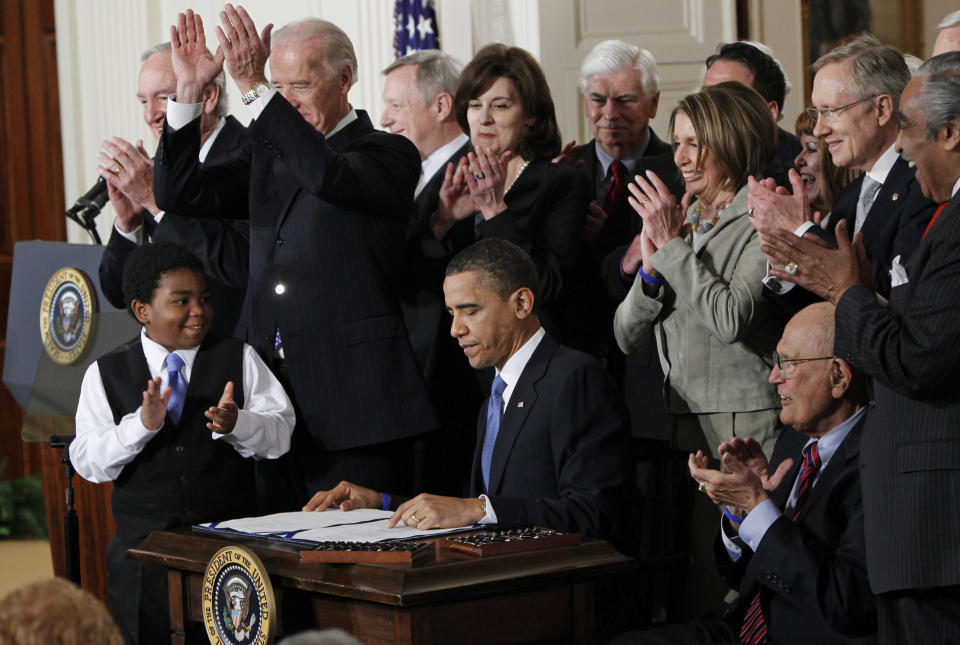
WASHINGTON (AP) — It took only a year to set up Medicare. But if President Barack Obama's health care law survives Supreme Court scrutiny, it will be nearly a decade before all its major pieces are in place.
And that means even if Obama is re-elected, he won't be in office to oversee completion of his signature domestic policy accomplishment, assuming Republicans don't succeed in repealing it.
The law's carefully orchestrated phase-in is evidence of what's at stake in the Supreme Court deliberations that start March 26.
The Affordable Care Act gradually reorganizes one-sixth of the U.S. economy to cover most of the nation's 50 million uninsured, while simultaneously trying to restrain costs and prevent disruptions to the majority already with coverage.
Despite the political rhetoric about what "Obamacare" is doing to the nation, only a fraction of the law is in effect.
"We really haven't seen the main game," said Drew Altman, president of the California-based Kaiser Family Foundation, a nonprofit information clearinghouse on the health care system. "The major provisions that will affect the most people and cost the most money don't go into effect until 2014 or later."
What has taken effect in the two years since the law was enacted has produced both successes and clunkers, and some surprises.
Few expected a relatively minor provision tacked on late in the legislative process to be its biggest success so far. But allowing young adults to stay on their parents' insurance until age 26 has added nearly 2.5 million people to the coverage rolls, at no cost to taxpayers.
Despite Republican pledges to repeal the overhaul, it's arguably the Obama administration that has done more to scale it back.
Health and Human Services Secretary Kathleen Sebelius decided to pull the plug on a long-term care insurance program seen as a budget drain. She also decided that Washington would not dictate a basic health benefits package for the country, allowing each state to set its own, within limits.
Medicare recipients gained more protection from high prescription costs and better preventive coverage, but older people remain the age group most opposed to the law, concerned that cuts to the program to finance benefits for the uninsured eventually will compromise their own care.
If the Supreme Court overturns the law entirely, that would present an immediate dilemma about popular early benefits such as coverage for young adults and prescription savings for seniors.
"These provisions give immediate relief to a small percentage of people, but it's a lot of relief," said economist Len Nichols of George Mason University in Virginia.
Other early benefits have been a mixed bag.
Millions of people are getting preventive care that now must be provided at no additional cost to patients. Birth control for women soon will be on that list. Insurance premium increases are getting more scrutiny.
But a program of tax credits for small businesses has seen little acceptance. The administration is in the awkward position of asking congressional Republicans to help fix it.
A highly promoted program that provides a lifeline to people denied coverage because they already had medical problems has probably saved lives. But enrollment in the Pre-Existing Condition Insurance Plan has been disappointing, with only about 50,000 people nationwide.
Glenn Nishimura, a consultant from Little Rock, Ark., checked it out and found his premiums would come to about $6,300 a year.
"It's out of my price range," said Nishimura. It makes more financial sense to take care of his high blood pressure and high blood sugars by paying out-of-pocket and gambling that his health will hold up, he reasons. In three years he'll be eligible for better coverage under Medicare.
If the health care law is upheld, it will bring some relief against such risks for millions of people such as Nishimura.
Starting in 2014, insurers will have to accept all applicants regardless of prior health problems. Also that year, many middle-class people will qualify for federal subsidies to lower the cost of their premiums. Consumers will have access to competitively priced private insurance through new state-based markets called exchanges.
At the same time, Medicaid would be expanded greatly to cover millions more low-income people, childless adults who do not now qualify.
Between the two approaches, more than 30 million uninsured people are expected to obtain coverage. Millions more will gain the security of knowing they can't be turned down for health insurance if they switch jobs.
That's critical for Natalie Hough, a college sophomore from Hillsborough, N.C. An aspiring artist, Hough has a heart condition that probably would make her uninsurable if she had to apply on her own later in life. Starting in 2014, insurers will not be able to turn away people like her.
"It's definitely peace of mind, knowing that I can go to a hospital if I need to," she said. "I'm an art major, and I'm not going to make billions of dollars."
But such changes hinge on whether the law's requirement that most people have health insurance is upheld by the Supreme Court.
This individual mandate, the main target for the law's critics, also takes effect in 2014. Without it, many experts fear that the new exchanges, the state-based markets for private insurance, won't work. Healthy people would be tempted to postpone signing up until they get sick, raising costs for everybody.
Administration lawyers have advised the court that if it strikes down the mandate, it also should invalidate the requirement that private health insurers accept customers with health problems.
If the court leaves the rest of the law in place, the Medicaid expansion could continue.
But even if Obama's plan to expand coverage survives its test of constitutionality, expect the law's cost-control measures to remain under attack.
One is an independent board that would have the power to curb excessive increases in Medicare spending by ordering cuts if Congress fails to act first. Republicans call it a "rationing board," although the law specifically bars the yet-to-be-named panel from restricting access. The health care industry opposes the board; efforts to do away with it or diminish its role seem to be gaining ground.
"It would work like a random tax on medical innovation," said economist Douglas Holtz-Eakin, a Republican adviser. "If you were an innovator, why would you want to bring something new to market when the biggest payer in the country is periodically lopping off spending?"
The other main cost-control measure is a tax on generous health insurance plans. Labor unions oppose it.
It won't take effect until 2018, a year after a second Obama term would have ended.
___
Online:
Health care law: http://www.healthcare.gov/
Supreme Court: http://tinyurl.com/3zukoc4
EDITOR'S NOTE _ This is part of a weeklong package of stories previewing the Supreme Court's consideration of President Barack Obama's health care overhaul law
