

President Obama Awards National Medals of Science and Technology at the White House
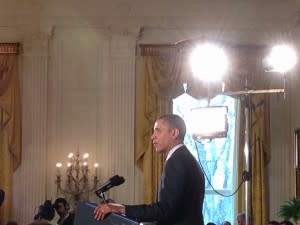
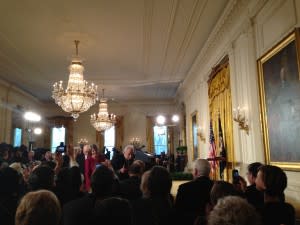
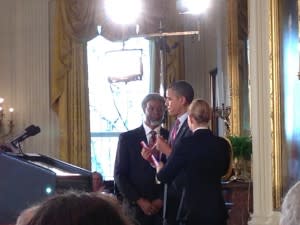
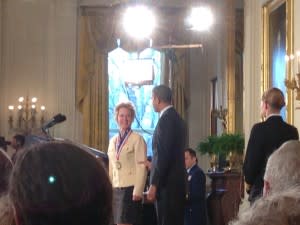
"You have improved our lives in ways that are practical and inspirational," said President Barack Obama. He saluted the top U.S. researchers with the highest honors bestowed by the U.S. government, the National Science and Technology Medals. At the White House ceremony on February 1, he honored 12 winners for the National Medals of Science and 11 winners of the National Medals of Technology and Innovation for pioneering work in developments including lithium-ion batteries, LASIK surgery, string theory and biofuels.
The occasion marked the 50th anniversary of the National Medals of Science, which was created by statute in 1959 and is administered for the White House by the National Science Foundation. The National Medal of Technology and Innovation, begun in 1980, honors individuals, teams, and companies for achievement in the innovation, development, commercialization, and management of technology.
Obama noted the importance of such events in inspiring young people to pursue careers in science, technology, engineering and mathematics (STEM): "We can celebrate and lift up and spotlight scientists like we're doing today."
National Medals of Science
Allen J. Bard, University of Texas at Austin
For contributions in electrochemistry, including electroluminescence, semiconductor photoelectrochemistry, electroanalytical chemistry and the invention of the scanning electrochemical microscope.
Sallie W. Chisholm, Massachusetts Institute of Technology
For contributions to the discovery and understanding of the dominant photosynthetic organisms in the ocean, promotion of the field of microbial oceanography and influence on marine policy and management.
Related stories in Scientific American:
"The Cells That Rule the Seas"
"The Little Plankton That Could--Maybe"
Sidney D. Drell, Stanford University
For contributions to quantum field theory and quantum chromodynamics, application of science to inform national policies in security and intelligence and distinguished contributions as an adviser to the United States Government.
Related stories in Scientific American:
"Special Report: New Nukes Are Good Nukes?"
Sandra M. Faber, University of California, Santa Cruz
For leadership in numerous path-breaking studies of extragalactic astronomy and galaxy formation, and for oversight of the construction of important instruments, including the Keck telescopes.
Related stories in Scientific American:
"Accelerated Expectations: All Eyes on Large Hadron Collider in Dark Matter Hunt"
Sylvester James Gates, Jr., University of Maryland
For contributions to the mathematics of supersymmetry in particle, field and string theories and extraordinary efforts to engage the public on the beauty and wonder of fundamental physics.
Solomon W. Golomb, University of Southern California
For pioneering work in shift register sequences that changed the course of communications from analog to digital, and for numerous innovations in reliable and secure space, radar, cellular, wireless and spread-spectrum communications.
John B. Goodenough, University of Texas, Austin
For groundbreaking cathode research that led to the first commercial lithium ion battery, which has since revolutionized consumer electronics with technical applications for portable and stationary power.
M. Frederick Hawthorne, University of Missouri
For highly creative pioneering research in inorganic, organometallic and medicinal borane chemistry, sustained and profound contributions to scientific and technical advice related to national security, and for effective, prolific and devoted service to the broad field of chemical sciences.
Leroy Hood, Institute for Systems Biology
For pioneering spirit, passion, vision, inventions and leadership combined with unique cross-disciplinary approaches resulting in entrepreneurial ventures, transformative commercial products and several new scientific disciplines that have challenged and transformed the fields of biotechnology, genomics, proteomics, personalized medicine and science education.
Related stories in Scientific American:
"Any Knowledge That Might Be Useful: Leroy Hood"
"Revolutionizing the Fight against Cancer"
"Systems Biology: The Future of Biomedical Science?"
"The Naked Singularity Meets Social Media" podcast
Barry C. Mazur, Harvard University
For original and landmark contributions to differential topology, number theory and arithmetic algebraic geometry, where, among other applications, his work was foundational to Wiles' proof of Fermat's Last Theorem, and for his dedication to communicating subtle mathematical ideas to the broader public.
Lucy Shapiro, Stanford University
For the pioneering discovery that the bacterial cell is controlled by an integrated genetic circuit functioning in time and space that serves as a systems engineering paradigm underlying cell differentiation and ultimately the generation of diversity in all organisms.
Related stories in Scientific American:
"Illusions: Motion from Brightness"
Anne M. Treisman, Princeton University
For a 50-year career of penetrating originality and depth that has led to the understanding of fundamental attentional limits in the human mind and brain.
Related stories in Scientific American:
National Medals of Technology and Innovation
Frances H. Arnold, California Institute of Technology
For pioneering research on biofuels and chemicals that could lead to the replacement of pollution-generating materials.
Related stories in Scientific American:
"Can Space Travel Be Environmentally Friendly?"
George Carruthers, U.S. Naval Research Lab
For invention of the Far UV Electrographic Camera, which significantly improved our understanding of space and earth science.
Robert Langer, Massachusetts Institute of Technology and member of Scientific American's Board of Advisers
For inventions and discoveries that led to the development of controlled drug release systems, engineered tissues, angiogenesis inhibitors and new biomaterials.
Related stories in Scientific American:
"This Really Won't Hurt a Bit: Wireless Sensor Promises Diabetics Noninvasive Blood Sugar Readings"
"Millennium Foundation Recognizes Inventors and Technologies That Changed the World"
"Small Comfort: Nanomedicine Able to Penetrate Bodily Defenses"
Norman R. McCombs, AirSep Corp.
For the development and commercialization of pressure-swing adsorption oxygen-supply systems with a wide rage of medical and industrial applications that have led to improved health and substantially reduced health care costs.
Gholam A. Peyman, University of Arizona College of Medicine and Arizona Retinal Specialists
For invention of the LASIK surgical technique, and for developing the field of intraocular drug administration and expanding the field of retinal surgery.
Arthur H. Rosenfeld, American Council for an Energy-Efficient Economy and California Institute for Energy and Environment
For extraordinary leadership in the development of energy-efficient building technologies and related standards and policies.
Related stories in Scientific American:
"Quantum Graviton Particles May Resemble Ordinary Particles of Force"
Jan T. Vil?ek, New York University School of Medicine
For pioneering work on interferons and key contributions to the development of therapeutic monoclonal antibodies.
Samuel Blum, Rangaswamy Srinivasan and James Wynne, IBM Thomas J. Watson Research Center
For the pioneering discovery of excimer laser ablative photodeomposition of human and animal tissue, laying the foundation for PRK and LASIK laser refractive surgical techniques that have revolutionized vision enhancement.
For sustained innovation through the engineering of first-of-kind, practical systems in acoustics, signal processing and information technology.
Follow Scientific American on Twitter @SciAm and @SciamBlogs. Visit ScientificAmerican.com for the latest in science, health and technology news.
© 2013 ScientificAmerican.com. All rights reserved.
