

Reviving the Woolly Mammoth: Will De-Extinction Become Reality?

Biologists briefly brought the extinct Pyrenean ibex back to life in 2003 by creating a clone from a frozen tissue sample harvested before the goat's entire population vanished in 2000. The clone survived just seven minutes after birth, but it gave scientists hope that "de-extinction," once a pipedream, could become a reality.
Ten years later, a group of researchers and conservationists gathered in Washington, D.C., today (March 15) for a forum called TEDxDeExtinction, hosted by the National Geographic Society, to talk about how to revive extinct animals, from the Tasmanian tiger and the saber-toothed tiger to the woolly mammoth and the North American passenger pigeon.
Though scientists don't expect a real-life "Jurassic Park" will ever be on the horizon, a species that died a few tens of thousands of years ago could be resurrected as long as it has enough intact ancient DNA.
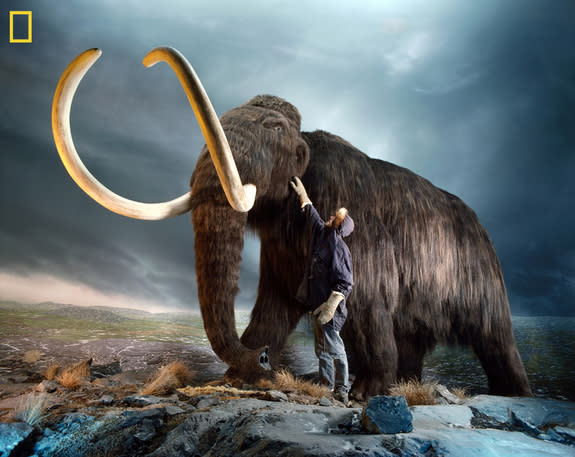
Some have their hopes set on the woolly mammoth, a relative of modern elephants that went extinct 3,000 to 10,000 years ago and left behind some extraordinarily well preserved carcasses in Siberian permafrost. Scientists in Russia and South Korea have embarked on an ambitious project to try to create a living specimen using the DNA-storing nucleus of a mammoth cell and an Asian elephant egg — a challenging prospect, as no one has ever been able to harvest eggs from an elephant. [Image Gallery: Bringing Extinct Animals Back to Life]
But DNA from extinct species doesn't need to be preserved in Arctic conditions to be useful to scientists — researchers have been able to start putting together the genomes of extinct species from museum specimens that have been sitting on shelves for a century. If de-extinction research has done anything for science, it's forced researchers to look at the quality of the DNA in dead animals, said science journalist Carl Zimmer, whose article on de-extinction featured on the cover of the April issue of National Geographic magazine.
"It's not that good but you can come up with techniques to retrieve it," Zimmer told LiveScience.
For instance, a team that includes Harvard genetics expert George Church is trying to bring back the passenger pigeon — a bird that once filled eastern North America's skies. They have been able to piece together roughly 1 billion letters (Each of four amino acids make up DNA has a letter designation) in the bird's genome based on DNA from a 100-year-old taxidermied museum specimen. They hope to incorporate those genes responsible for certain traits into the genome of a common rock pigeon to bring back the passenger pigeon, or at least create something that looks like it.
A few years ago, another group of researchers isolated DNA from a 100-year-old specimen of a young thylacine, also known as Tasmanian tiger. The pup had been preserved in alcohol at Museum Victoria in Melbourne. Its genetic material was inserted into mouse embryos, which proved functional in live mice. [Photos: The Creatures of Cryptozoology]
Should we?
Now that de-extinction looms as a possibility, it presents some thorny questions: Should we bring back these species? And what would we do them?
Stuart Pimm of Duke University argued in an opinion piece in National Geographic that these efforts would be a "colossal waste" if scientists don't know where to put revived species that had been driven off the planet because their habitats became unsafe.
"A resurrected Pyrenean ibex will need a safe home," Pimm wrote. "Those of us who attempt to reintroduce zoo-bred species that have gone extinct in the wild have one question at the top of our list: Where do we put them? Hunters ate this wild goat to extinction. Reintroduce a resurrected ibex to the area where it belongs and it will become the most expensive cabrito ever eaten."
Pimm also worries that de-extinction could create a false impression that science can save endangered species, turning the focus away from conservation. But others argue that bringing back iconic, charismatic creatures could stir support for species preservation.
"Some people feel that watching scientists bring back the great auk and putting it back on a breeding colony would be very inspiring," Zimmer told LiveScience. The great auk was the Northern Hemisphere's version of the penguin. The large flightless birds went extinct in the mid-19th century.
Other species disappeared before scientists had a chance to study their remarkable biological abilities — like the gastric brooding frog, which vanished from Australia in the mid-1980s, likely due to timber harvesting and the chytrid fungus.
"This was not just any frog," Mike Archer, a paleontologist at the University of New South Wales, said during his talk at TEDxDeExtinction, which was broadcast via livestream. These frogs had a unique mode of reproduction: The female swallowed fertilized eggs, turned its stomach into a uterus and gave birth to froglets through the mouth.
"No animal, let alone a frog, has been known to do this – change one organ in the body into another," Archer said. He's using cloning methods to put gastric brooding frog nuclei into eggs of living Australian marsh frogs. Archer announced today that his team has already created early-stage embryos of the extinct species forming hundreds of cells.
"I think we're gonna have this frog hopping glad to be back in the world again," he said.
Editor's Note: This story has been updated to correct the year the Pyrenean ibex clone was created.
Email Megan Gannon or follow her @meganigannon. Follow LiveScience on Twitter @livescience. We're also on Facebook & Google+. Original article on LiveScience.com
Copyright 2013 LiveScience, a TechMediaNetwork company. All rights reserved. This material may not be published, broadcast, rewritten or redistributed.
