
Russia Meteor Blast Was Largest Detected by Nuclear Monitoring System
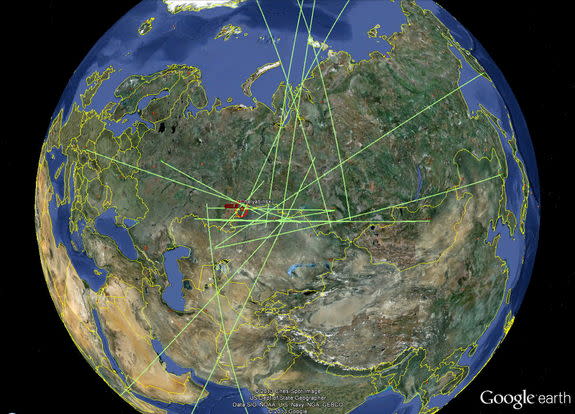

A far-flung system of detectors that make up a Comprehensive Nuclear-Test-Ban Treaty network made its largest ever detection when a meteor exploded over Russia’s Ural mountains last week.
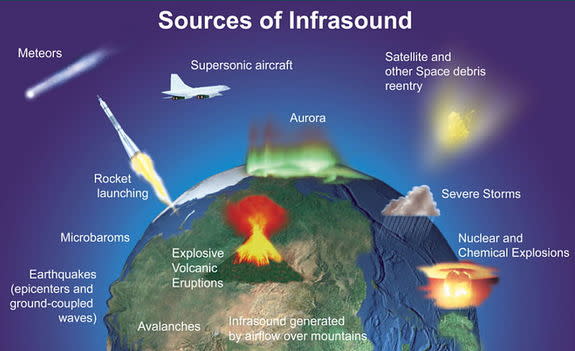
The Vienna, Austria-based Comprehensive Nuclear-Test-Ban Treaty Organization (CTBTO) runs the International Monitoring System made up of infrasound stations. Infrasound is low frequency sound with a range of less than 10 Hertz. Humans cannot hear the low frequency waves that were emitted by the meteor blast over Russia on Friday (Feb. 15), but they were recorded by the CTBTO’s network of sensors as they travelled across continents.
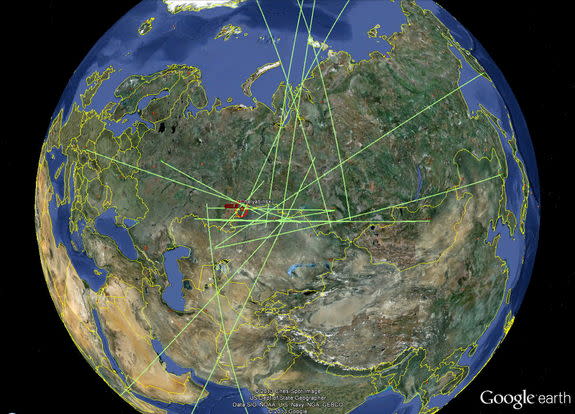
When the space rock detonated, the blast was detected by 17 infrasound stations in the CTBTO’s network that track atomic blasts across Earth. The furthest station to record the sub-audible sound was some 9,320 miles (15,000 kilometers) away in Antarctica.
Huge infrasound event
Prior to the Russian meteor event, the largest infrasound event registered by 15 stations in the CTBTO’s network was the October 2009 meteor explosion (called a bolide) over Sulawesi, Indonesia. [See video of the intense meteor explosion]
In a CTBTO statement discussing the Russian bolide, Pierrick Mialle, an acoustic scientist for the group said: "We saw straight away that the event would be huge, in the same order as the Sulawesi event from 2009. The observations are some of the largest that CTBTO's infrasound stations have detected."
The Russian meteor blast picked up by the detectors is not a single explosion, Mialle said. Rather, it is burning, traveling faster than the speed of sound. "That's how we distinguish it from mining blasts or volcanic eruptions," he said.
Mialle said that scientists around the world will be using the CTBTO's data to better gauge the object's breakup and discern more about the object's final altitude, energy released and how the meteor disintegrated.
Micropressure changes
There are currently 45 infrasound stations in the CTBTO's network that measure micropressure changes in the atmosphere generated by infrasonic waves. Infrasound is one of the technologies used in the CTBTO’s network of sensors to monitor the globe for violations of the Comprehensive Nuclear-Test-Ban Treaty that bans all nuclear explosions.
Infrasound has been used as part of the CTBTO's tools to detect atomic blasts since April 2001 when the first station came online in Germany. Data from the stations is sent in near real time to Vienna, Austria, for analysis at the CTBTO’s headquarters. Both the raw and analyzed data are provided to all Member States of the CTBTO.
CTBTO Member States have spent $1 billion on setting up the CTBTO verification regime.
Just days before the meteor explosion over Russia, the CTBTO's seismic network detected a seismic event in North Korea. That event on Feb. 12 measured 4.9 in magnitude. Later that morning, North Korean officials announced that the country had conducted a nuclear test. The event was registered by 94 seismic stations and two infrasound stations in the CTBTO's network.
Leonard David has been reporting on the space industry for more than five decades. He is former director of research for the National Commission on Space and a past editor-in-chief of the National Space Society's Ad Astra and Space World magazines. He has written for SPACE.com since 1999.
Copyright 2013 SPACE.com, a TechMediaNetwork company. All rights reserved. This material may not be published, broadcast, rewritten or redistributed.
