
SKorean court rules Samsung didn't copy iPhone

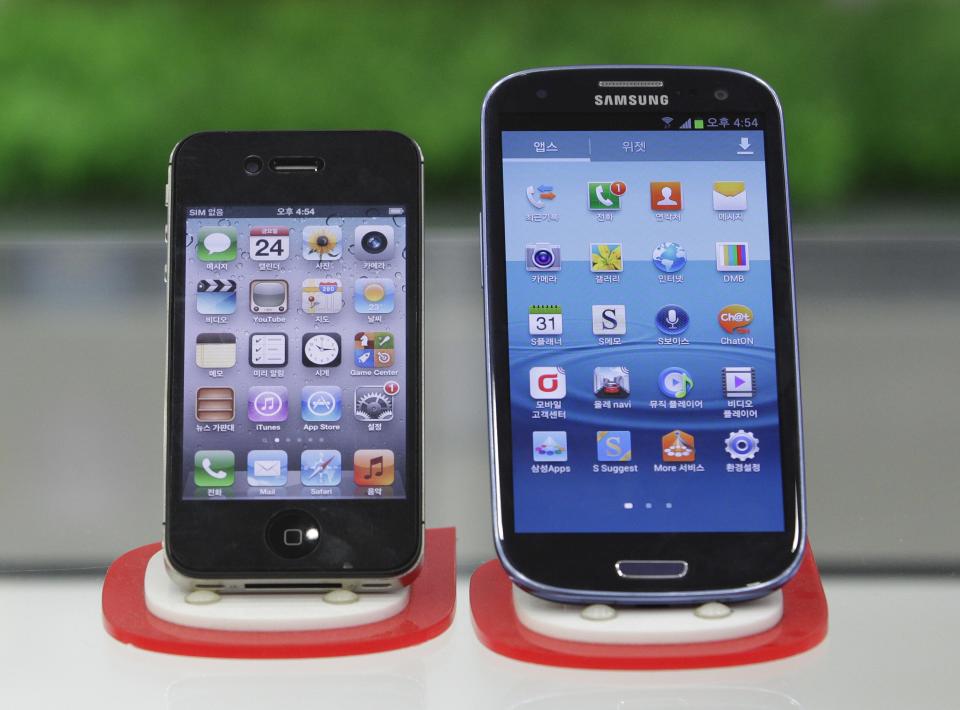

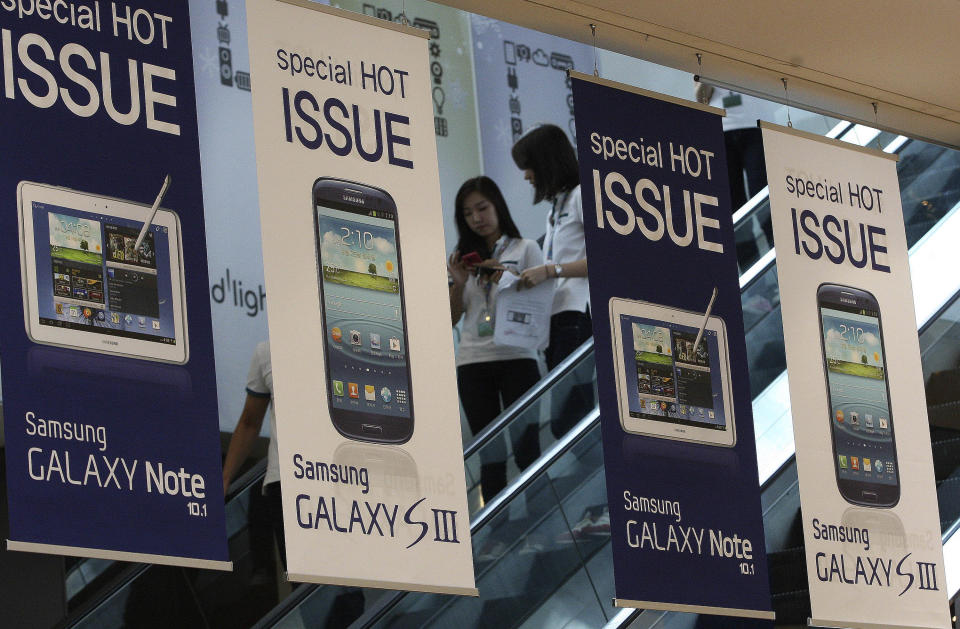


SEOUL, South Korea (AP) — South Korean phone maker Samsung won a home court ruling Friday in its global patent battle against Apple and its popular iPhone and iPad devices.
The ruling came hours before Apple prevailed in a similar case in the U.S.
Judges in Seoul said Samsung Electronics Co. didn't copy the look and feel of the iPhone and ruled that Apple infringed on Samsung's wireless technology.
However, the judges also said Samsung violated Apple's technology behind a feature that causes a screen to bounce back when a user scrolls to an end image. Both sides were ordered to pay limited damages.
The Seoul Central District Court ruling called for a partial ban on products from both companies, though the verdict did not affect the latest-generation phones — Apple's iPhone 4S or Samsung's Galaxy S III — or the newest iPad. Both sides were also ordered to pay limited damages.
The ban applies only to sales in South Korea, and the ruling is part of a larger, epic struggle over patents and innovation unfolding in nine countries.
The biggest stakes are in the U.S., where Apple is seeking $2.5 billion from Samsung over allegations it has created illegal knockoffs of iPhones and iPads. Hours after the South Korean ruling, a federal jury in San Jose, California, ruled that Samsung ripped off the innovative technology used by Apple to create the iPhone and the iPad.
The jury ordered Samsung to pay Apple $1.05 billion, though an appeal is expected. A judge was expected to rule later on whether Samsung must pull devices from the U.S. market.
The fact that both rulings came Friday was coincidental. The judge overseeing the U.S. case had ordered jurors there to refrain accessing any news regarding the two companies.
The Seoul ruling was a rare victory for Samsung in its arguments that Apple has infringed on its wireless technology patents. Those arguments previously have been shot down by courts in Europe, where judges have ruled that they are part of industry standards that must be licensed under fair terms to competitors.
"This is basically Samsung's victory on its home territory," said patent attorney Jeong Woo-sung. "Out of nine countries, Samsung got the ruling that it wanted for the first time in South Korea."
The ruling ordered Apple to remove the iPhone 3GS, the iPhone 4, the original iPad and the iPad 2 from store shelves in South Korea, saying that the products infringed on two of Samsung's five disputed patents, including those for telecommunications technology. South Korea is not a big market for Apple.
The court also denied Apple's claim that Samsung had illegally copied its design, ruling that big rectangular screens in cases with rounded corners had existed in products before the iPhone and iPad.
"It is not possible to assert that these two designs are similar based only on the similarity of those features," the court said in a ruling issued in Korean and translated into English by The Associated Press. It also said individual icons in the Samsung products do not appear similar to the icons Apple used in the iPhone.
But the court ruled that Samsung had infringed on one of Apple's patents, covering the bounce-back feature. The court banned sales of Samsung products using the technology, including the older Galaxy S II, in South Korea.
Court spokesman Kim Mun-sung said the court's ruling was to take effect immediately, although companies often request that sanctions be suspended while they evaluate their legal options, such as an appeal.
Nam Ki-yung, a spokesman for Samsung, said the ruling "affirmed our position that one single company cannot monopolize generic design features."
Apple did not respond to multiple calls seeking comment.
The court ordered each company to pay monetary compensation to its competitor. Samsung must pay Apple 25 million won ($22,000) while Apple must pay its rival 40 million won.
Some industry watchers expressed concern over the South Korean ruling to protect industry standard patents. They say the decision could invite a trade war by giving Samsung and fellow South Korean company LG Electronics Inc. — both industry standard patent holders — more room to block rivals' entrance into South Korea if they don't agree to licensing terms.
"It would mean that foreign companies would either have to bow to Samsung's and LG's demands ... or stop selling in Korea," said Florian Mueller, a patent expert in Munich, Germany, who has been closely following the case.
Courts in Europe, including Netherlands, France, Italy and Germany, have rejected similar claims by Samsung that Apple violated its wireless patents, with judges arguing that the patents have become part of industry standards. Standard-essential patents are a crucial technology for new players to make products compatible with the rest of the market and must be licensed under fair and reasonable terms.
Europe's antitrust regulator launched an investigation earlier this year into whether Samsung was failing to license those patents under fair and reasonable terms.
In Friday's ruling, the South Korean court said Samsung did not abuse its market power as an industry standard patent holder.
Samsung, which is based in Suwon, South Korea, filed a complaint in South Korea against Apple shortly after Apple filed its lawsuit in the U.S.
Apple claims some of Samsung's smartphones and tablet computers are illegal knockoffs of Apple's iPhone and iPad. Samsung denies the allegations and argues that all companies in the cutthroat phone industry mimic each other's successes without crossing the legal line. Apple, which is based in Cupertino, California, wants $2.5 billion and Samsung's most popular products pulled from the U.S. market.
The battle is more complex as Apple and Samsung are not only competitors in the fast-growing global market for smartphones and tablet computers, but also have a close business relationship.
Samsung, the world's biggest manufacturer of memory chips and liquid crystal displays, supplies some of the key components that go into Apple products, including mobile chips that work as a brain of the iPhone and the iPad.
The South Korean firm overtook Apple in less than three years in smartphone markets. In the second quarter of this year, Samsung sold 50.2 million units of smartphones, nearly twice as many as Apple's 26 million units, according to IDC.
Despite the ruling that is widely seen as Samsung's victory, Samsung's share fell 0.9 percent in Seoul.
___
AP Business Writer Kelvin Chan in Hong Kong contributed to this report.
Follow Youkyung Lee on Twitter at http://twitter.com/YKLeeAP
