How Space Robots Could Heal, Learn Like Living Creatures
PASADENA, Calif. — No living creature born on Earth has evolved to live in space. But the next wave of space robots may use "bio-inspired" designs based on specialized jellyfish cells, lemur climbing skills or even the fast-learning brain of a human child.
Living organisms still have two huge advantages over even the best space robots — biological creatures can heal themselves and they have nervous systems capable of learning from the surrounding environment. At the American Institute of Aeronautics and Astronautics' Space 2012 Conference & Exposition on Sept. 12, robotics researchers from NASA and the U.S. military talked about their hopes for someday making space robots that mimic those biological abilities through self-repair mechanisms and "brains" based on learning software.
"When a 2- or 3-year-old [child] falls down and skins a knee, it learns about the environment and heals itself," said Brett Kennedy, a robotics engineer at the NASA Jet Propulsion Laboratory in Pasadena, Calif. "It can afford to learn from mistakes so that it doesn't have to make the same mistakes again."
Kennedy represented one of four panelists talking about bio-inspired robots at the conference.
Robot resurrection
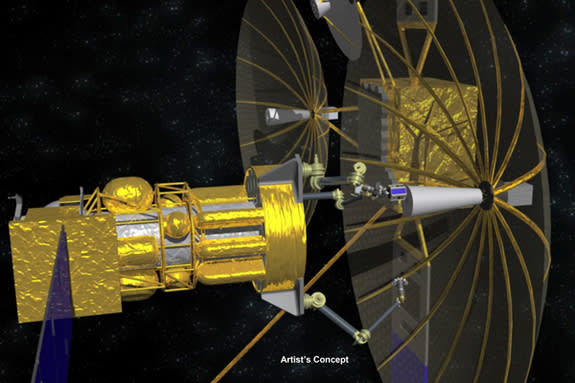
The idea of self-healing space robots remains far from reality, but the U.S. military's Defense Advanced Research Projects Agency (DARPA) has gotten the ball rolling with its "Phoenix" program that cobbles together new satellites from parts belonging to old or dead satellites drifting in orbit.
The program takes inspiration from the humble jellyfish — a creature with just 22 specialized cells making up the millions in its body. DARPA hopes to create a new generation of small satellites, each like a specialized cell, which could interchangeably combine to deliver the full capabilities of a modern satellite. [DARPA's Futuristic Phoenix Satellite Re-Servicing Program]
Such a bold step could preview more ambitious efforts. David Barnhart, manager for DARPA's Phoenix program, speculated about even wilder biology-inspired possibilities. He asked his fellow panelists when they thought humans could "grow a spacecraft" like a living creature.
"What we're talking about is getting rid of these mechanical claptraps," Barnhart said. "Phoenix is so archaic when you think about it, even though it's a big step to resurrect spacecraft."
Kennedy responded that growing spacecraft wouldn't happen for a "long while," but pointed out that 3D printing could create spacecraft from scratch within a few decades — with the right interest and funding.
Step-by-step learning
On the learning side, robots with such capabilities may be just decades away, said Brian Wilcox, a robotics engineer at the NASA Jet Propulsion Laboratory. Learning software has a big advantage over nonlearning programs that must be coded by humans — a process that becomes monstrously complex and requires long lines of computer code when trying to replicate animal or human intelligence on a computer chip.
Humans may find it tough to verify all the lines of code in self-learning machines. But Wilcox suggested that people could still check whether the robots had learned what we wanted them to learn by interacting with them, similar to how parents check up on their preschoolers.
"If we can't afford to write software in the traditional way and allow them to learn like a human child learns, do it like you do with humans — get to know them and trust them as individuals," Wilcox said.
Surprises in biological mimicry
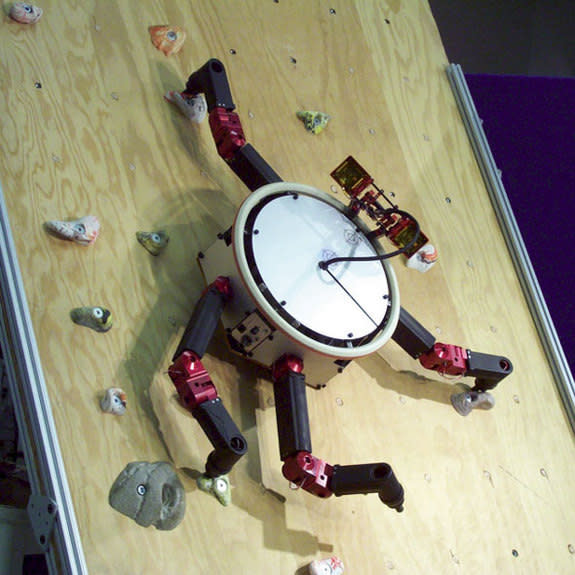
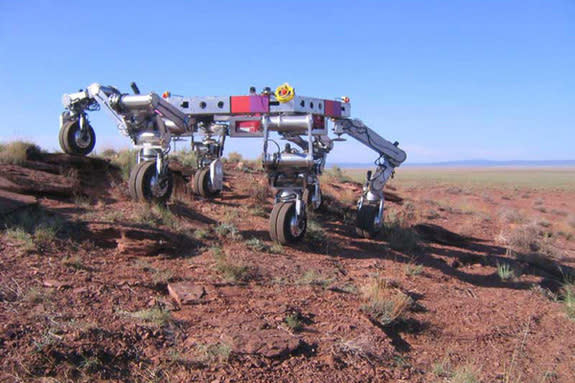
Many robots taking inspiration from biology mimic the natural designs of living things. Kennedy's work includes testing NASA's six-legged LEMUR robots that resemble headless, robotic primates capable of gripping, climbing and hanging. Wilcox has worked on NASA's six-legged ATHLETE robots that have wheels on the ends of their legs — a "hybrid" of biological inspiration.
But living creatures still have plenty of tricks that robots have only just begun to mimic. For example, an octopus can squeeze its squishy body through incredibly small spaces, said Yoseph Bar-Cohen, NASA Jet Propulsion Laboratory. Both animals and plants can pull off camouflage and color changes with impressive results. And even the basic act of walking or climbing across rough terrain remains challenging for robots.
"Mountain goats might be an inspiring model for all-terrain, legged rovers," Bar-Cohen said.
The gap between robots and living creatures seems frustrating at times. But it also means researchers have no shortage of source material for applying bio-inspiration to their robots. Kennedy pointed to a two-wheel robot with many tiny spines covering the wheels that enable it to drive right up walls or stairs — a mechanical version of how cockroaches climb walls with their spiny legs.
"With biologically inspired technology, you never know where you'll end up," Kennedy said.
This story was provided by InnovationNewsDaily, sister site to SPACE.com. You can follow InnovationNewsDaily Senior Writer Jeremy Hsu on Twitter @ScienceHsu. Follow InnovationNewsDaily on Twitter @News_Innovation, or on Facebook.
Copyright 2012 SPACE.com, a TechMediaNetwork company. All rights reserved. This material may not be published, broadcast, rewritten or redistributed.
