
Speed of Universe's Expansion Measured Better Than Ever
The universe just got a new speeding ticket.
The most precise measurement ever made of the speed of the universe's expansion is in, thanks to NASA's Spitzer Space Telescope, and it's a doozy. Space itself is pulling apart at the seams, expanding at a rate of 74.3 plus or minus 2.1 kilometers (46.2 plus or minus 1.3 miles) per second per megaparsec (a megaparsec is roughly 3 million light-years).
If those numbers are a little too much to contemplate, rest assured that's really, really fast. And it's getting faster all the time.
American astronomer Edwin P. Hubble first discovered that our universe isn't static in the 1920s. In fact, Hubble found, space has been expanding since it began with the Big Bang 13.7 billion years ago. Then, in the 1990s, astronomers shocked the world again with the revelation that this expansion is speeding up (this discovery won its finders the 2011 Nobel Prize in physics).
Ever since Hubble's initial discovery, scientists have been trying to refine their measurement of the universe's expansion rate, called the Hubble Constant. It's a hard measurement to make.
The new value reduces the uncertainty in the Hubble Constant to just 3 percent, and improves the precision of the measurement by a factor of 3 compared to a previous estimate from the Hubble Space Telescope.
"Just over a decade ago, using the words 'precision' and 'cosmology' in the same sentence was not possible, and the size and age of the universe was not known to better than a factor of two," Wendy Freedman of the Observatories of the Carnegie Institution for Science in Pasadena, Calif., said in a statement. "Now we are talking about accuracies of a few percent. It is quite extraordinary." [7 Surprising Facts About the Universe]
The new measurement doesn't just tell scientists how fast the universe is expanding, but helps shed light on the mystery of why this expansion is accelerating. Dark energy is the name given to whatever is causing the universe's expansion to speed up. Yet scientists have little idea what it is.
By combining the new value of the Hubble Constant with observations of the universe by NASA's Wilkinson Microwave Anisotropy Probe (WMAP), the scientists were able to make an independent calculation of the strength of dark energy, which is battling against gravity to pull the universe outward.
"This is a huge puzzle," Freedman said. "It's exciting that we were able to use Spitzer to tackle fundamental problems in cosmology: the precise rate at which the universe is expanding at the current time, as well as measuring the amount of dark energy in the universe from another angle."
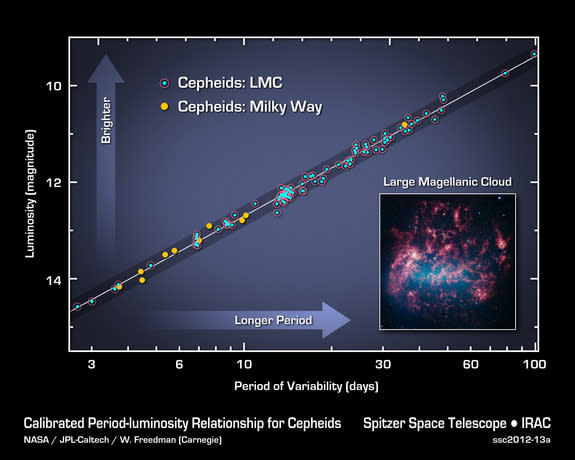
Spitzer spies the universe in long-wavelength infrared light not visible to the human eye, which allowed it to peer through obscuring dust to the distant universe. The telescope focused on variable stars called cepheids, which are reliable distance indicators because their intrinsic brightness can be calculated based on their pulsing light. If their intrinsic brightness is known, then their distance can be estimated by comparing their apparent brightness, because the farther away stars are, the more their light dims.
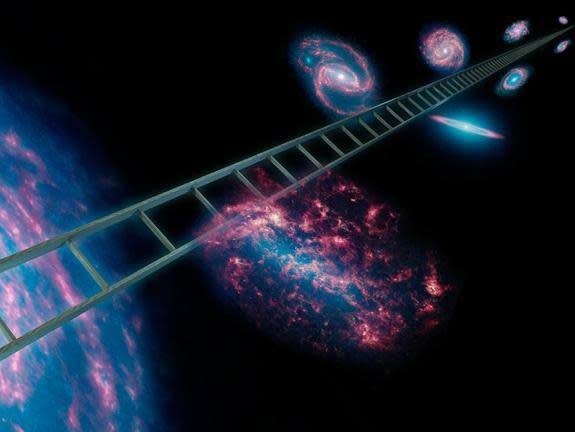
"These pulsating stars are vital rungs in what astronomers call the cosmic distance ladder: a set of objects with known distances that, when combined with the speeds at which the objects are moving away from us, reveal the expansion rate of the universe," said Glenn Wahlgren, Spitzer program scientist at NASA Headquarters in Washington.
Spitzer observed 90 cepheid stars, and was able to measure their apparent brightness more precisely than previous studies, leading the way to a more refined measurement of their distances, and the expansion rate of space.
The Spitzer telescope was launched in August 2003, and ran out of cryogenic coolant to chill its instruments in May 2009. Without coolant, the observatory can't see in all the wavelengths it was originally designed for. Since then, however, Spitzer's been running on a second, "warm" mission that's proven fruitful as well.
The new findings are reported in a paper published in the Astrophysical Journal.
Follow Clara Moskowitz on Twitter @ClaraMoskowitz or SPACE.com @Spacedotcom. We're also on Facebook & Google+.
Copyright 2012 SPACE.com, a TechMediaNetwork company. All rights reserved. This material may not be published, broadcast, rewritten or redistributed.
