
War photography exhibit debuts in Houston museum


HOUSTON (AP) — It was a moment Nina Berman did not expect to capture when she entered an Illinois wedding studio in 2006. She knew Tyler Ziegel had been horribly injured, his face mutilated beyond recognition by a suicide bombing in the Iraq War. She knew he was marrying his pretty high school sweetheart, perfect in a white, voluminous dress.
It was their expressions that were surprising.
"People don't think this war has any impact on Americans? Well here it is," Berman says of the image of a somber bride staring blankly, unsmiling at the camera, her war-ravaged groom alongside her, his head down.
"This was even more shocking because we're used to this kind of over-the-top joy that feels a little put on, and then you see this picture where they look like survivors of something really serious," Berman added.
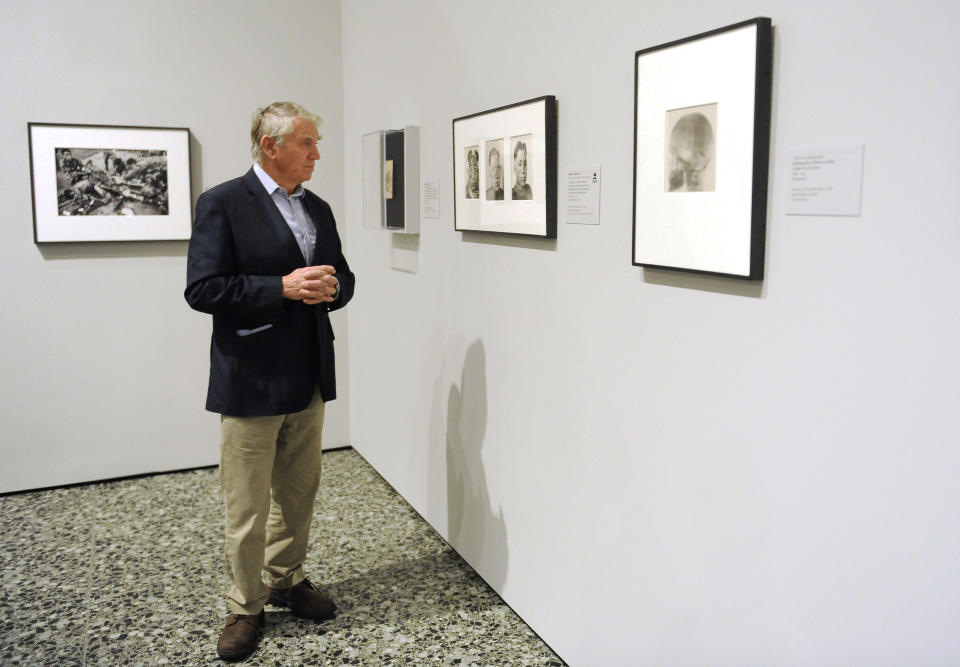
The photograph that won a first place prize in the World Press Photos Award contest will stand out from other battlefield images in an exhibit "WAR/PHOTOGRAPHY: Images of Armed Conflict and Its Aftermath" that debuts Sunday — Veterans Day — in the Houston Museum of Fine Arts. From there, the exhibit will travel to The Annenberg Space for Photography in Los Angeles, the Corcoran Gallery of Art in Washington and The Brooklyn Museum in Brooklyn, N.Y.
The exhibit was painstakingly built by co-curators Anne Wilkes Tucker and Will Michels after the museum purchased a print of the famous picture of the raising of the flag at Iwo Jima, taken Feb. 23, 1945, by Associated Press photographer Joe Rosenthal. The curators decided the museum didn't have enough conflict photos, Tucker said, and in 2004, the pair began traveling around the country and the world in search of pictures.
Over nearly eight years and after viewing more than 1 million pictures, Tucker and Michels created an exhibit that includes 480 objects, including photo albums, original magazines and old cameras, by 280 photographers from 26 countries.
Some are well-known — such as the Rosenthal's picture and another AP photograph, of a naked girl running from a napalm attack during the Vietnam War taken in 1972 by Huynh Cong "Nick" Ut. Others, such as the Incinerated Iraqi, of a man's burned body seen through the shattered windshield of his car, will be new to most viewers.
"The point of all the photographs is that when a conflict occurs, it lingers," Tucker said.
The pictures hang on stark gray walls, and some are in small rooms with warning signs at the entrance designed to allow visitors to decide whether they want to view images that can be brutal in their honesty.
"It's something that we did to that man. Americans did it, we did it intentionally and it's a haunting picture," Michels said of the image of the burned Iraqi that hangs inside one of the rooms.
In some images, such as Don McCullin's picture of a U.S. Marine throwing a grenade at a North Vietnamese soldier in Hue, it is clear the photographer was in danger when immortalizing the moment. Looking at his image, McCullin recalled deciding to travel to Hue instead of Khe Sahn, as he had initially planned.
"It was the best decision I ever made," he said, smiling slightly as he looked at the picture, explaining that he took a risk by standing behind the Marine.
"This hand took a bullet, shattered it. It looked like a cauliflower," he said, pointing to the still-upraised hand that threw the grenade. "So the people he was trying to kill were trying to kill him."
McCullin, who worked at that time for The Sunday Times in London, has covered conflicts all over the world, from Lebanon and Israel to Biafra. Now 77, McCullin says he wonders, still, whether the hundreds of photos he's taken have been worthwhile. At times, he said, he lost faith in what he was doing because when one war ends, another begins.
Yet he believes journalists and photographers must never stop telling about the "waste of man in war."
"After seeing so much of it, I'm tired of thinking, 'Why aren't the people who rule our lives ... getting it?' " McCullin said, adding that he'd like to drag them all into the exhibit for an hour.
Berman didn't see the conflicts unfold. Instead, she waited for the wounded to come home, seeking to tell a story about war's aftermath.
Her project on the wounded developed in 2003. The Iraq War was at its height, and there was still no database, she said, to find names of wounded warriors returning home. So she scoured local newspapers on the Internet.
In 2004 she published a book called "Purple Hearts" that includes photographs taken over nine months of 20 different people. All were photographed at home, not in hospitals where, she said, "there's this expectation that this will all work out fine."
The curators, meanwhile, chose to tell the story objectively — refusing through the images they chose or the exhibit they prepared to take a pro- or anti-war stance, a decision that has invited criticism and sparked debate.
And maybe, that is the point.
___
Plushnick-Masti can be followed on Twitter at https://twitter.com/RamitMastiAP
