

Worse Than Bedbugs, It s the Couch Itself


Last week, millions of Americans ceremoniously started the Holiday Gorge by putting off their diet and exercise resolutions as they helped themselves to another (and another?) slice of pie. Then, with the grace of an elephant in a tutu, they plopped triumphantly onto their favorite couch to bask in the bliss of their food comas. And while you'd have to be living in the most absurd bubble not to know that these types of lifestyle decisions - overeating, eating the wrong things, not exercising enough, and repeating day after day after day - are what's killing most of us, many of us are not aware of another legitimate threat to our modern-day struggle to survive: it's that couch you collapsed on.
See, when you sank down into the cushy goodness of your favorite couch or chair, your freshly fed derriere forced the air out of those foam cushions and with it came a poof of dust. Ever wonder what's in that dust? If pressed to answer what makes up the couch foam we sit on, most of us would shrug our shoulders and reply it's foam and air, but most of us would be dead wrong. As it turns out, there is a third component very few of us know about: our couch foam is up to 11% by weight flame retardant chemicals. And according to two new studies released today in Environmental Science and Technology, these chemicals are not necessarily guests you'd have invited into your home for Thanksgiving or otherwise. One such chemical, Tris, was banned from children's clothing in the 1970s because of concern over its ability to cause cancer, one is the globally-banned pentaBDE, a known hormone disruptor and neurotoxin in animals. And still others are completely untested for safety, despite structural similarities to known carcinogens and other toxic substances.
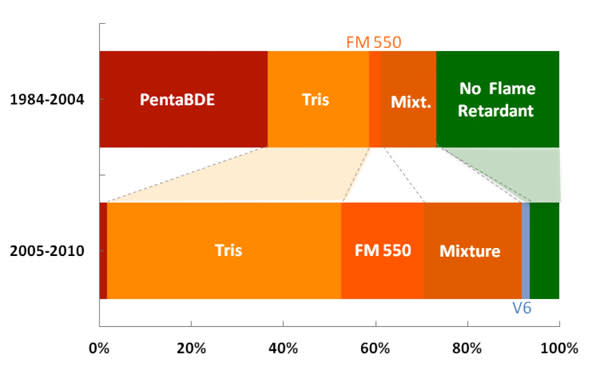
So back to that poof of dust displaced by your tush. The flame retardants in your couch foam don't stay put; in fact, these pesky chemicals perpetually migrate out and are found in high concentrations in household dust (as if dust bunnies weren't sinister enough). If it were as simple as sweeping this dust under the proverbial rug, that would be that. But blood samples confirm that these chemicals are making their way into our bodies. In 2004, Americans had more than 15 times the levels of pentaBDE in their systems than Europeans. And toddlers have 3 times the levels of adults. PentaBDE was phased out of furniture foam in 2004, but discouragingly, it is being replaced with our old friend Tris (see fig 1). Meanwhile, the option to purchase flame-retardant-free furniture is diminishing to essentially nothing.
Nobody knows what elevated levels of these chemicals in our bodies means for our long-term health, but there have been some studies that suggest it is particularly worrisome for pregnant women and their developing fetuses. Even if you're not a pregnant woman or a fetus, with cancer deaths due to environmental pollutants responsible for an estimated 30,000 deaths per year (compare that to 2650 deaths on average in house fires annually), known carcinogens in large concentrations in your home are probably something to be aware of. If you are one of the millions of people who have purged plastics containing bisphenol-A (BPA) from your life because of concerns over its ability to mimic estrogen in our bodies (and do nasty things like increase the risk of breast cancer), there's no reason you shouldn't be concerned about flame retardant chemicals for similar reasons. Even more so since BPA is removed from your body quickly after your last exposure to the chemical. In contrast, many flame retardants accumulate in your body fat and stick with you for years.
The kicker in all of this is that these flame retardant chemicals added to our furniture foam don't even do what they should - that is, reduce risk of house fires, or increase our safety in the event of one. In the latter case, they may actually increase our risk; most fire deaths are due to smoke inhalation, not complications from burns, and flame retardants actually increase the amount of smoke and toxic gases. (In one study, pentaBDE doubled the smoke, created 7 times the carbon monoxide and 88 times the soot - all for a three second delay in ignition). Not only that, but when the flame retardants do burn, they produce dioxins and furans, highly toxic compounds believed to contribute to the higher rates of cancer among fire fighters.
So how are flame retardants at preventing fires in the first place? Unfortunately the data there are damning as well. The current requirement for fire safety is set by a California standard, TB117, which states that furniture foam must withstand exposure to an open flame for 12 seconds before igniting. In theory, this sounds good, but in practice, furniture foam is almost always safely encased in fabric, which itself can have flame retardant properties without the use of added chemicals. In fact, a study conducted by the Consumer Products Safety Commission estimated that 85% of upholstered furniture would require no change to their product to meet fire safety standards for smoldering if the flame retardant chemicals were eliminated from their foam. And while fire safety proponents cite the decline in upholstered fabric fires since the addition of these chemicals into our couch foam, the decline also correlates beautifully with the decrease in smoking since the 1980s. And smoking is by far the leading cause of upholstered fabric fires.
Of the average of 2650 people who die in house fires each year in the United States, only 500 deaths are attributable to fires that were started on upholstered furniture. This begs the question: are we exposing ourselves, our children and our pets daily to known toxic chemicals to prevent the extremely remote chance that we will be killed in a house fire? Considering there are smarter, safer ways to protect our favorite couch from being a fire hazard, we need to reevaluate California's fire safety standard that sets the nation's standard and in so doing, provide alternatives for concerned consumers.
Fortunately, the governor of California has called for a revised furniture standard in 2013 that aims to improve fire safety without requiring the use of unsafe flame retardants. If the proposed changes are implemented, it should be possible to purchase fire-safe furniture without added flame retardants in the foam by next summer.
Video by Mollie Bloudoff-Indelicato, Marissa Fessenden and Isha Soni.
Related:
Infographic: Fire Safety Buzzkill
Learn more at:
Green Science Policy Institute: www.greensciencepolicy.og
Center for Environmental Research & Children's Health: cerch.org/
Silent Spring Institute: silentspring.org/
Further references:
Stapleton, H. et. al, 2012. Novel and High Volume Use Flame Retardants in US Couches Reflective of the 2005 PentaBDE Phase Out.
Dodson, R. et. al, 2012. After the PBDE Phase-Out: A Broad Suite of Flame Retardants in Repeat House Dust Samples from California
Stapleton, H. et. al, 2012: Serum PBDEs in a North Carolina Toddler Cohort: Associations with Handwipes, House Dust, and Socioeconomic Variables
Patisaul, H.B. et. al, 2012: Accumulation and Endocrine Disrupting Effects of the Flame Retardant Mixture Firemaster((R)) 550 in Rats: An Exploratory Assessment.
Harley, K.G. et. al, 2011: Association of prenatal exposure to polybrominated diphenyl ethers and infant birth weight.
Follow Scientific American on Twitter @SciAm and @SciamBlogs. Visit ScientificAmerican.com for the latest in science, health and technology news.
© 2012 ScientificAmerican.com. All rights reserved.
